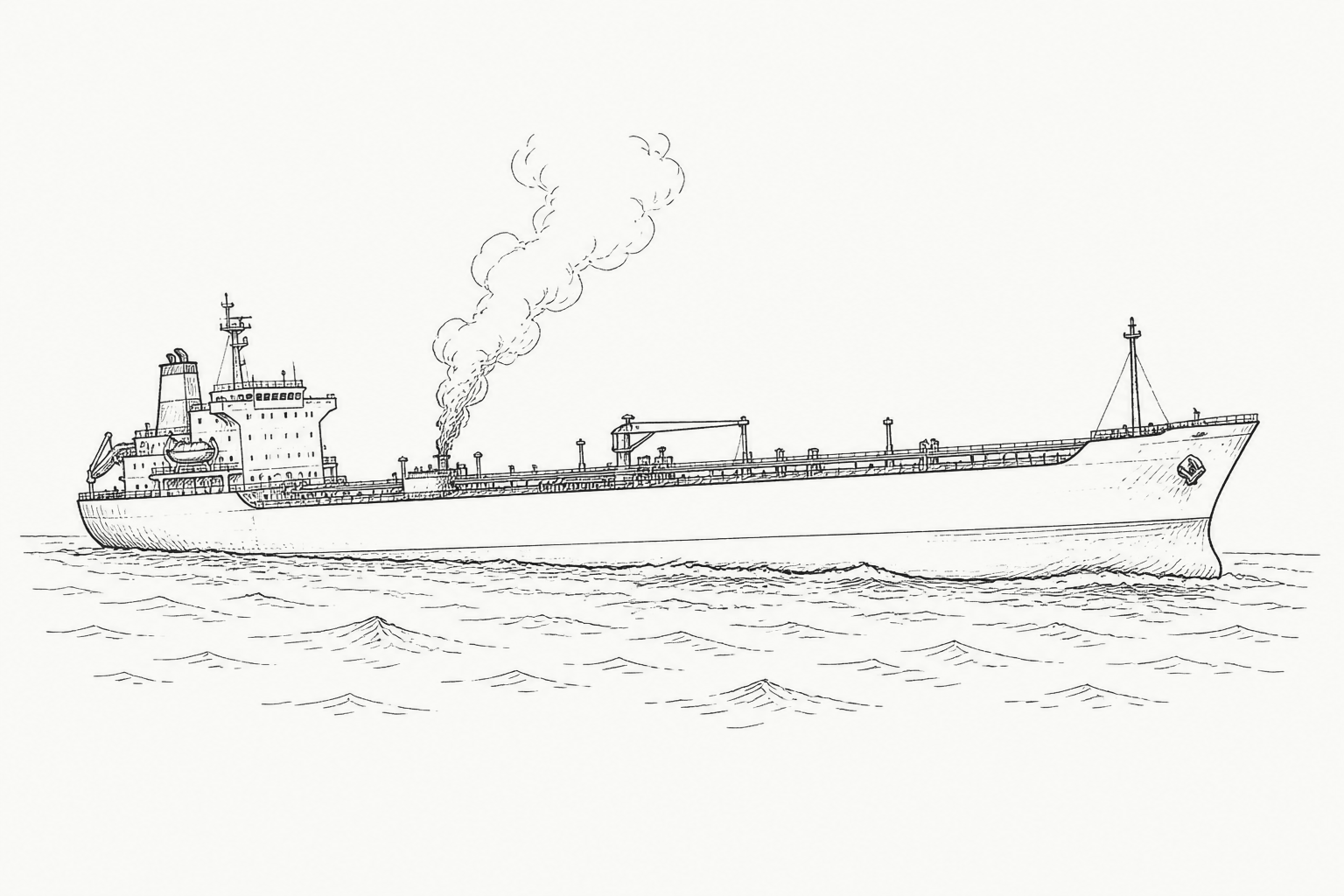
DUBAI — U.S. Central Command destroyed or disabled three Iranian oil tankers in the Persian Gulf on Saturday in retaliation for Iranian ballistic-missile fire at a U.S. aircraft carrier and a guided-missile destroyer, and by Sunday the speaker of Iran's Parliament had warned that "the era of proportionate responses has come to an end."
The exchange marked the sharpest escalation since Washington and Tehran resumed strikes across the Strait of Hormuz last weekend, ending a monthlong lull in the six-month war that began Feb. 28. It knocked out a chunk of Iran's already-shrunken export fleet, held Brent crude near a six-week high around $95 a barrel and left American drivers paying a record $5.85 a gallon for diesel on Labor Day weekend, with midterm elections two months away.
What was hit
CENTCOM said the tanker M/T Downy was struck off Kharg Island, through which Iran shipped roughly 90 percent of its crude before the war, and the M/T Stark 1 was hit near Jask; both were "permanently disabled." The unladen M/T Kylo was completely destroyed in the Gulf of Oman after its crew was directed to abandon ship, the command said. Video of all three strikes was posted to CENTCOM's social-media accounts.
The tanker strikes followed Iranian ballistic-missile fire at the aircraft carrier and guided-missile destroyer earlier Saturday, which CENTCOM said its ships "successfully evaded." No American personnel were injured.
"If you shoot at two of our ships, we will impose an even higher economic cost — taking out three of yours," Adm. Brad Cooper, the CENTCOM commander, said in a statement. "We will not hesitate to defend American forces, and if necessary, destroy Iran's limited and exposed oil fleet."
Tehran's answer
Iran's Islamic Revolutionary Guard Corps said its naval forces "targeted three oil tankers on the unauthorised route of the Strait of Hormuz and three vessels affiliated with the child-killing America in other areas," warning other ships not to attempt the same routes. On Sunday, the Guard said it had attacked an unmanned U.S. surface vessel trying to enter the strait.
Parliament Speaker Mohammad Bagher Ghalibaf raised the rhetorical stakes in a Sunday speech carried by state television, warning that "any aggression against Iran's interests and security will receive a faster, more intense and more painful response."
Danny Citrinowicz, an Iran specialist at Israel's Institute for National Security Studies, wrote on X that Iran's decision to aim ballistic missiles at a U.S. carrier "indicates that Tehran is becoming increasingly willing to accept risks it previously sought to avoid, including directly threatening some of the most important U.S. military assets in the region."
The chokepoint
Traffic through the Strait of Hormuz, which carried roughly 20 percent of the world's oil before the war, remained a fraction of prewar volumes. Lloyd's List Intelligence counted 102 transits last week, down from 126 the week before and 130 or more a day before Feb. 28. Marine-analytics firm Kpler put the 10-day average at just 13 vessels a day.
Treasury Secretary Scott Bessent told the U.K.'s Times last week that roughly 17 million barrels of crude a day were still flowing out — a figure Al Jazeera said it could not independently verify. President Trump said last month the U.S. was in "total control" of the waterway.
Politics and price
Trump on Friday called the fighting "small potatoes," and Vice President JD Vance told reporters he would not describe it as a war, saying "Right now, there is no active shooting." Vance would not predict when gasoline prices might ease.
The polling shows otherwise. A Reuters/Ipsos survey conducted in late August found 63 percent of Americans opposed to the war and 31 percent in support; Trump's approval rating stood at 33 percent, down from 40 percent when the fighting began. The national average for regular gasoline hit $4.15 a gallon Friday, according to AAA, the first time the pump price has topped $4 on Labor Day.
Washington's case
CENTCOM and Treasury officials cast the strikes as a proportionate defense of U.S. warships and a squeeze on the finances of the IRGC, which Washington has designated a foreign terrorist organization. Defense Secretary Pete Hegseth had previewed the response the day before, writing on social media, "It's simple: if Iran shoots at US ships, we will destroy (and sink) their oil tankers." Conservative outlets that generally support the campaign are not represented in today's reporting, which drew on CBS News, the BBC and Al Jazeera; a fuller right-of-center rebuttal to the polling picture was not available at press time.
What's next
The International Atomic Energy Agency's Board of Governors is due to consider a resolution from the United States, Britain, France and Germany next week in Vienna that would refer Iran to the U.N. Security Council for failing to comply with its nuclear nonproliferation obligations, a step Russian and Chinese vetoes would blunt but that would sharpen the diplomatic front Washington has built alongside its military and financial campaign.