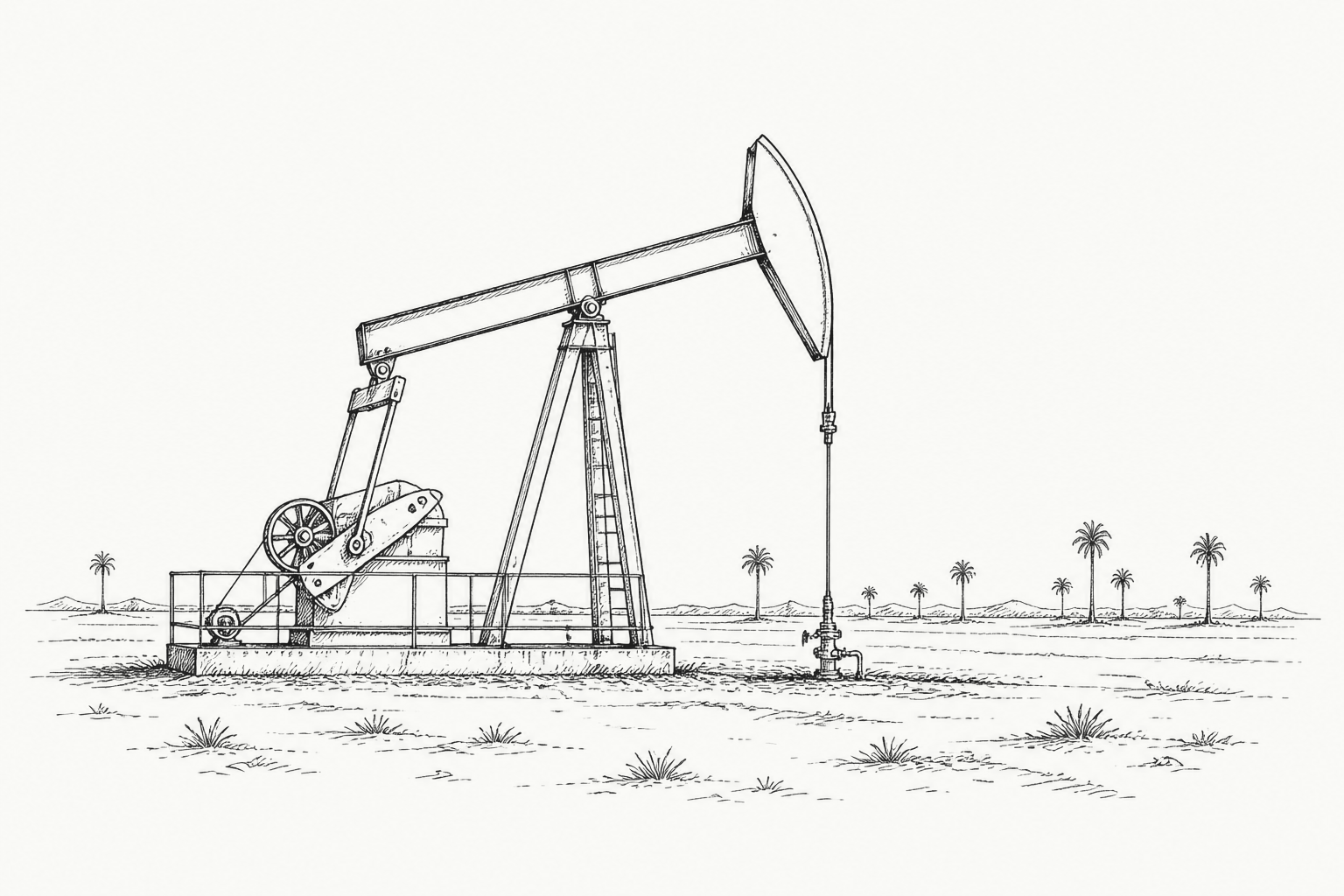
LA GUAIRA, Venezuela — Energy Secretary Chris Wright landed at this Caribbean port on Wednesday to sign the operational framework of the U.S.-Venezuela oil pact President Trump announced last week, arriving alongside Chevron's confirmation that it will spend about $7 billion over five years to double its Venezuelan production to roughly 600,000 barrels a day.
The signing puts American capital and personnel back on the ground in Venezuela's Orinoco Belt for the first sustained expansion since Hugo Chávez expropriated ExxonMobil's assets there nearly two decades ago. It commits the second-largest U.S. oil company to a $7 billion outlay in a country whose extra-heavy crude sits behind decayed infrastructure, and it aligns the corporate rollout with the federal joint venture Trump unveiled Aug. 28. Chevron said its Venezuelan barrels cost about $20 apiece to produce.
Chevron's Orinoco bet
Chevron said it has been assigned rights to develop the adjacent Carabobo 1 and Carabobo-2-South-A blocks in the Orinoco Belt, on top of the extra-heavy joint ventures — Petroindependencia, Petropiar and Petroboscan — that the company has run in Venezuela since 1923. Chief Executive Mike Wirth said in a statement that "With improved terms and additional acreage, we are strengthening a portfolio that we believe can deliver attractive low-cost oil growth, support energy supply and create differentiated long-term value." The five-year, $7 billion outlay is aimed at lifting production from roughly 300,000 barrels a day to 600,000.
The federal framework
Wright's arrival formalized the accord that gives a private joint venture called North American Blue Energy Partners a 100-year concession over 17 fields containing about 65 billion barrels — roughly a fifth of Venezuela's proven reserves. A White House fact sheet released Tuesday said Washington will hold veto power over the appointment of NABEP directors and that a majority of the company's board must be U.S. citizens. NABEP, run by Venezuelan businessman Alejandro Betancourt, is the country's second-largest private producer after Chevron. Interior Secretary Doug Burgum told Fox Business the arrangement was "shifting the geopolitical centre of the global energy markets" away from the Middle East.
Opposition
The pact drew objections across Venezuela's political spectrum. Elliott Abrams, Trump's former special representative on Venezuela and Iran, called it "a terrible deal" whose terms amounted to a "fever dream of what colonialism looks like." Economist Ricardo Hausmann wrote on social media that Secretary of State Marco Rubio had chosen "to use the power of the United States not to liberate Venezuelans, but to ally yourself with our oppressors." Rafael Ramírez, the former head of state oil company PDVSA and Chávez-era oil minister, said the accord opens the door to "a new colonialism." Nobel Peace Prize laureate María Corina Machado, who presented her medal to Trump earlier this year, has so far declined to criticize the president in public.
Two competing frames
The BBC and Al Jazeera reported that Venezuelan opposition figures and Chavista socialists both view the pact as either a betrayal of the promised restoration of democratic rule or a capitulation to Washington, and noted that no election calendar has been set. A Fox News opinion contributor took the opposite view, arguing that a long-term U.S. commercial stake would block Cuban, Russian and Chinese re-entry and predicting the arrangement would be remembered as the moment Venezuela "shut the door on communism." The White House said the deal has "re-established the Monroe Doctrine."
Independent analysts say any payoff is years away. Dan Alamariu, chief geopolitical strategist at Alpine Macro, wrote in a research note that "Meaningful new barrels are years away" given Venezuela's extra-heavy crude and decayed infrastructure. Luis Pacheco of the Baker Institute at Rice University told BBC Mundo that Venezuela needs about $100 billion in oil-sector investment over eight years to recover the production levels it held three decades ago.
Wright and Chevron officials were expected to detail the investment schedule at events in Caracas later Wednesday. Venezuelan interim President Delcy Rodríguez's government has yet to publish an electoral timetable.