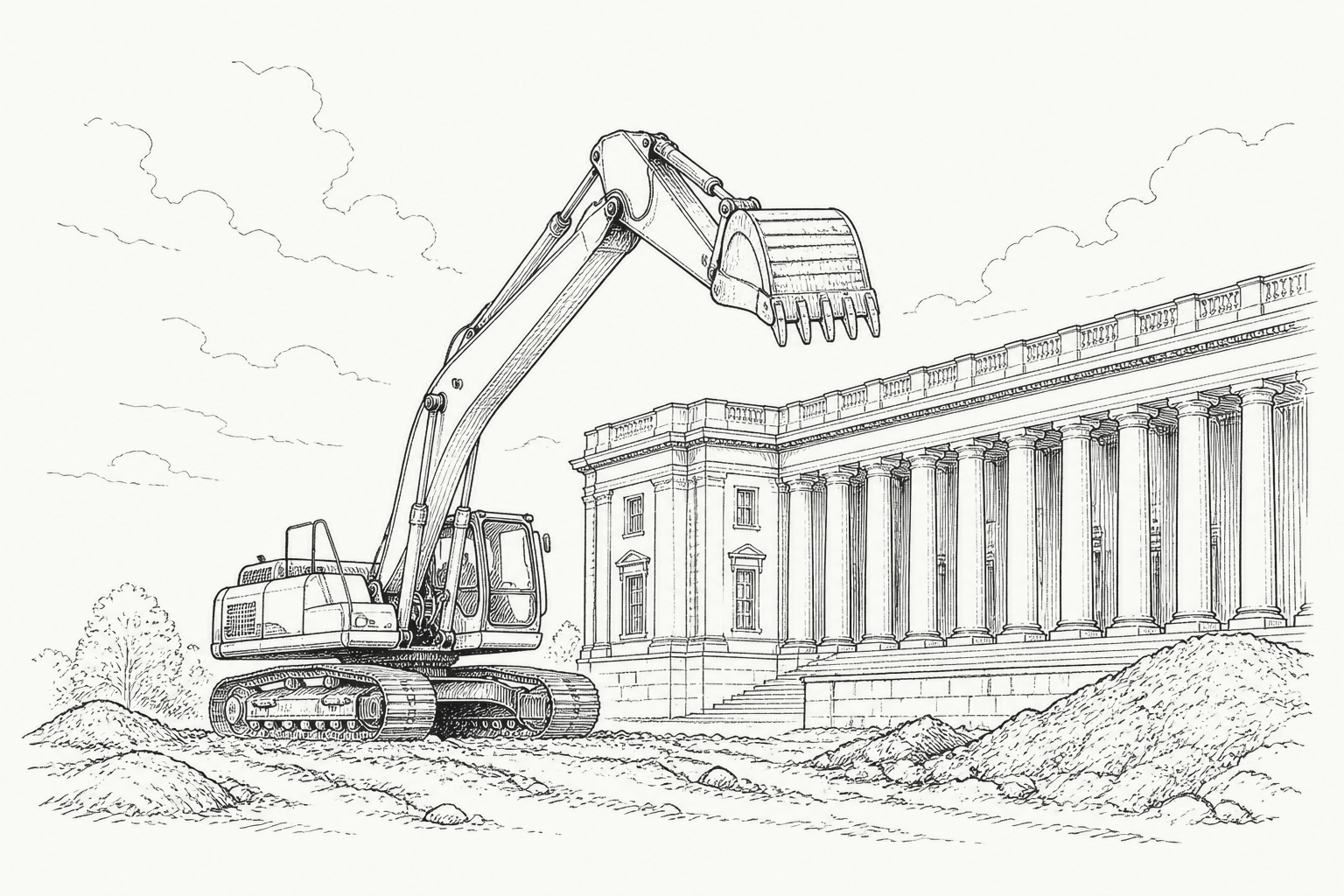

WASHINGTON — Chief Justice John Roberts on Friday temporarily froze a lower-court order that would have stopped above-ground construction of President Trump's $400 million East Wing ballroom, giving the Supreme Court more time to consider a Justice Department application to keep the injunction on hold while the case is briefed.
The stay, issued by Roberts in his capacity as circuit justice for the D.C. Circuit, is procedural and reversible. It preserves the status quo — continued construction — past a midnight deadline set by the appeals court, and the full court has yet to act. Friday's order follows a 2-1 D.C. Circuit ruling earlier this month that upheld the injunction against the project, a case that has moved through the federal courts since December.
What Roberts did
Roberts' order pauses an injunction that U.S. District Judge Richard Leon issued in March and that the U.S. Court of Appeals for the District of Columbia Circuit upheld in a divided decision. The appeals court had frozen its own ruling for 14 days, through Friday, to allow Solicitor General D. John Sauer time to seek relief from the Supreme Court.
The appeals panel concluded that Congress, not the president, has "full constitutional control over federal property and the funding of its maintenance and development," and found an "absence of any express or implied authorization" for Mr. Trump to build the 90,000-square-foot ballroom without lawmakers' approval. Below-ground work — including a presidential security bunker and medical facilities — has continued throughout the litigation, and Leon clarified in April that those elements were not covered by his order.
The administration's case
Sauer told the justices that Leon's order was "an extraordinary and unlawful injunction that will halt the ongoing construction of the integrated military complex, including a totally secure ballroom space, at the East Wing of the White House, which is vitally required by national security."
Sauer and Joshua Fisher, the White House official managing the project, argued in filings that stopping now is not physically feasible. Sauer called the district court's "stop-work mandate" "impossible" and said construction has passed "beyond the point of return." As of Aug. 14, according to the administration's filings, the project was 65 percent complete, with a 250-person crew working 20 hours a day, seven days a week.
Mr. Trump celebrated on Truth Social. "We are grateful for the Decision of the United States Supreme Court," he wrote. "The Military/Ballroom Complex being built on the hallowed grounds of the White House, which is so vital for National Security, will be THE GREATEST OF ITS KIND!" He added that "construction is under budget and ahead of schedule."
The plaintiffs' response
The National Trust for Historic Preservation, which filed the lawsuit in December, has accused the White House of trying to "outrun judicial review" by having "accelerated construction" during the appellate process. A trust spokesman said Friday that Roberts' order was not the end of the matter. "To be clear, this is not a final decision on the merits of the government's stay application, and we await further action," the spokesman said.
Leon had also ruled that the project's funding structure — donations routed through a nonprofit to the National Park Service and then to a White House maintenance fund — was unlawful. Mr. Trump has said most of the $400 million has been raised from private donors and corporate contributors including Lockheed Martin, Amazon and Microsoft.
Still to be heard
The substantive fight the justices will now weigh turns in part on whether the National Trust has legal standing to sue based on one of its members objecting to the ballroom on aesthetic grounds. Judge Leon had not publicly commented on Roberts' stay by Friday evening, and no other justice had issued a separate statement or dissent from the temporary order. The Trust's outside counsel had not addressed reporters on the record about the stay, and the administration had not filed a supplemental brief responding to Roberts' order.
The full Supreme Court is expected to act on the government's stay application in the coming days. Construction on the East Wing site, which began in October after demolition of the original building, continues in the meantime.