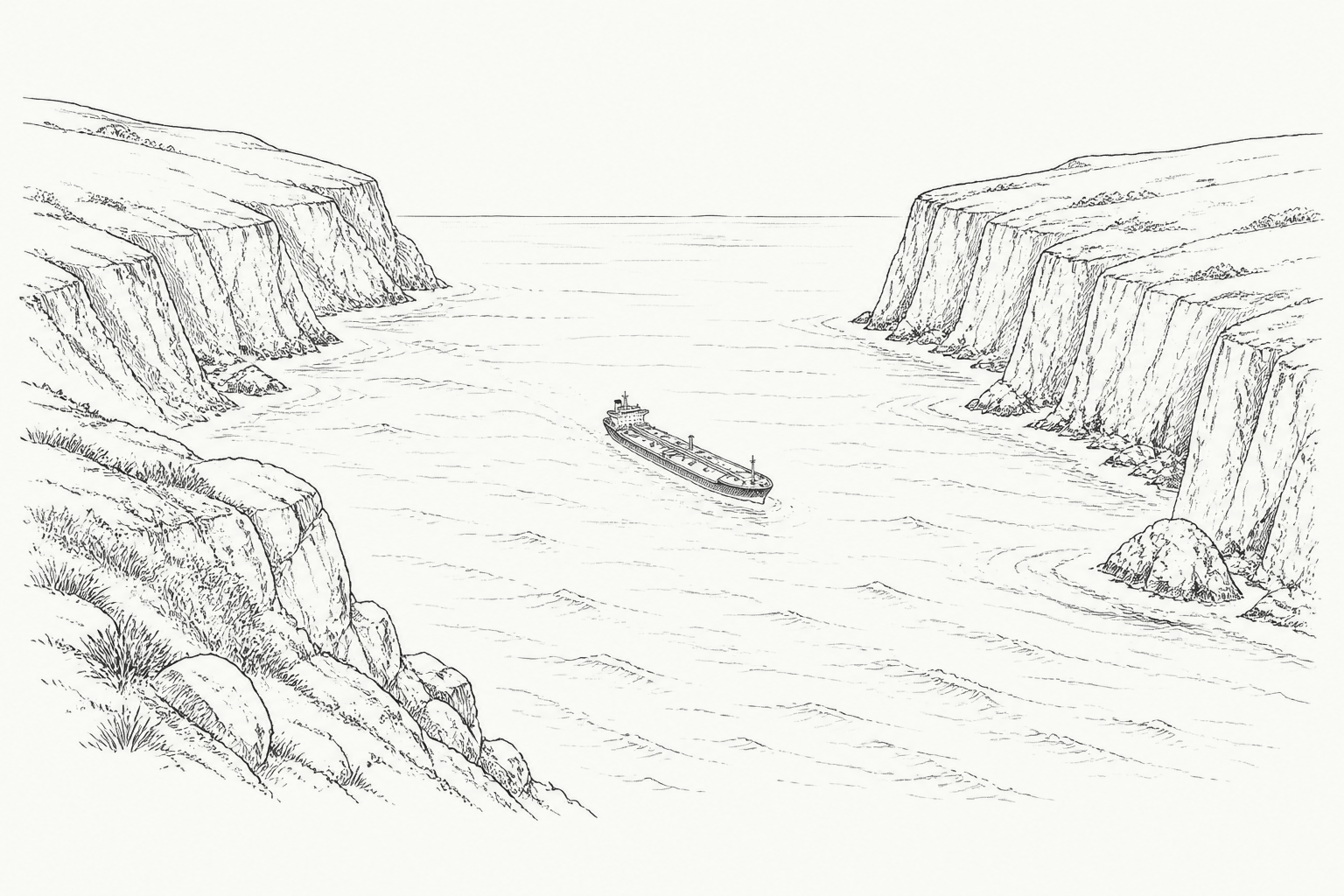

Iran's Islamic Revolutionary Guard Corps launched missile and drone attacks on U.S. military installations in Bahrain, Kuwait, Jordan and Oman on Monday and declared the Strait of Hormuz closed to shipping, driving an American-Iranian war that Washington and Tehran claimed to have ended in June to its most dangerous crossroads since the opening salvos in February.
The overnight barrage followed the U.S. military's third round of strikes on Iran in a week, a Saturday-night operation in which U.S. Central Command said it hit roughly 140 targets from missile and drone sites to naval batteries and coastal radar. The exchange drove oil sharply higher. Brent crude for September delivery advanced 2.8 percent to $78.14 a barrel, its highest level since June 22, while U.S. West Texas Intermediate for August climbed 2.5 percent to $73.24. Traffic through the world's most important oil chokepoint, a waterway that in peacetime handles about a fifth of the global crude trade, has collapsed to a trickle: six vessels crossed the strait on Sunday, according to the intelligence firm Kpler, against roughly 130 a day before the war.
On the strait
The Revolutionary Guards said they struck U.S. facilities in Juffair, Bahrain, where the Guards' statement said "fires are raging," and destroyed "the long-range airborne FPS radar and the ship-detection radar" at sites in Oman. In Kuwait, the Guards claimed to have set fire to two HIMARS rocket launchers at a U.S. surface-to-surface missile base. Jordan's military said its air defenses intercepted four Iranian missiles overnight, with no injuries or damage reported. Bahrain sounded air-raid sirens for the third time in as many days. A U.S. official told CBS News that "the overwhelming majority of Iranian missiles and drones launched were intercepted or shot down" and that no American forces had been hurt.
Washington and Tehran offered flatly contradictory accounts of whether the waterway remained navigable. The Persian Gulf Strait Authority, a body Iran established in May, said passage through the waterway was "currently not possible." U.S. Central Command replied that "Iran does not control the strait" and that "Traffic is flowing." The maritime intelligence firm Windward tallied nine vessels crossing between Saturday evening and Sunday morning, four of them Iranian-flagged.
Oil, stocks
Oil prices remain about 9 percent above their pre-conflict level, according to Al Jazeera, though still short of the peak reached after the U.S.-Israeli strikes on Iran in late February. Asian equities took the harder hit Monday. Japan's Nikkei 225 closed nearly 2 percent lower and South Korea's Kospi fell 9 percent.
Mukesh Sahdev, chief oil analyst at XAnalysts in Sydney, said in a note to clients Saturday that he expects Brent to hold in the upper $70s through August and September. "Long-haul procurement forces refiners to make supply decisions weeks in advance," Sahdev wrote, decisions that had already trimmed Western refiners' dependence on Middle Eastern crude before this weekend's escalation.
Washington and Tehran dig in
Defense Secretary Pete Hegseth posted on X shortly after Saturday's strikes: "Iran made a poor choice. Now they pay." Central Command said the operation had been ordered by President Trump "to hold Iranian forces accountable," and that U.S. forces had for the first time deployed "one-way attack aerial drones, and one-way attack sea drones" against Iranian air-defense systems, coastal radar sites, missile and drone capabilities and small boats. Central Command put the three-round total at more than 300 sites struck.
Retired Gen. Frank McKenzie, the former commander of Central Command, said Sunday on CBS's "Face the Nation" that U.S. forces "certainly have the capability to control the Strait of Hormuz if the president chooses to follow that course of action." Compelling concessions from Tehran, McKenzie added, requires directly pressuring the regime "in a way that perhaps is existential to them," the retired general said.
Iran's parliament speaker and lead negotiator, Mohammad Bagher Ghalibaf, posted Sunday: "The era of one-sided deals is OVER. We told you: keep your word or pay the price. Reality is knocking," alongside an image of Article 5 of the June memorandum of understanding on Hormuz traffic. Mohsen Rezaee, an adviser to Iran's supreme leader, told the semi-official ISNA news agency the waterway was "more important than dozens of atomic bombs, and the Islamic Republic of Iran will protect it," a formulation Iranian officials have repeated since Saturday.
Congress balks
Democrats returning from a two-week recess questioned the legality of the new campaign. "Congress voted against more war with Iran," Sen. Tim Kaine, D-Va., told Fox News Digital, referring to a non-binding resolution passed before the break. "The U.S. should not be launching new strikes without congressional authorization and restarting a war that has raised gas prices, killed Americans, and hurt the economy. The U.S. and Iran must return to a ceasefire." Senate Majority Leader John Thune, R-S.D., will manage a narrower majority this week after the death of Sen. Lindsey Graham of South Carolina, and Democrats are expected to force fresh war-powers votes as the chamber takes up the National Defense Authorization Act.
The two-month diplomatic window Washington and Tehran set in June is scheduled to reach its halfway point this week.