The United States hit about 90 Iranian military targets on Thursday in a second consecutive night of strikes, bombing two bridges on the road to Mashhad hours before Ayatollah Ali Khamenei's coffin arrived in the city for burial, as Iran's Health Ministry reported 14 people killed and 78 wounded across five southern provinces.
The exchange is the largest since Washington and Tehran signed a 60-day memorandum of understanding on June 17, and has effectively closed the Strait of Hormuz to Western-supervised shipping. Phil Belcher, marine director at the tanker owners' group Intertanko, told BBC Radio 4 that vessels crossing the U.S.-monitored southern corridor overnight numbered "sort of about single figures," down from about 70 a week ago and 130 before the war began in February. The International Maritime Organization said roughly 6,000 sailors remain trapped in and around the waterway.
What was hit
Al Jazeera and Iranian state media said Thursday's American strikes hit the southern port cities of Bandar Abbas, Sirik, Kuhestak, Chabahar, Jask and Konarak, along with Abu Musa island and Bushehr province. U.S. Central Command said the operation targeted air-defense systems, drone and missile storage, naval assets and coastal logistics infrastructure, and was meant to "further degrade Iran's ability to attack commercial shipping" in the Strait of Hormuz. Combined with Wednesday's round of about 80 targets, Centcom said, the two operations struck roughly 170 sites.
Ehsan Jahangirian, a deputy governor of Bushehr province, told state news agency IRNA that projectiles hit the perimeter of Iran's only commercial nuclear power plant, the Choghaddak military base and the Benoud fishing pier in Asaluyeh, setting fishing boats on fire. Local authorities said a strike on a fishing pier in Sirik killed three people and wounded 15; a firefighter died at the airport in Iranshahr, near the Pakistani border, and three more people were killed in Khuzestan province, state media reported. The Iranian Revolutionary Guard Corps said U.S. strikes also cut two bridges on the road to Mashhad, and railway authorities suspended passenger service on the Tehran-Mashhad line for repairs. The Fars News Agency said the Aq Taqeh Khan railway bridge, part of a northern trade corridor that links Tehran to China via Turkmenistan and Kazakhstan and has also carried cargo to Russia, was hit as well.
Iran's response
The Revolutionary Guards said their overnight barrage struck the Arifjan and Ali Al Salem bases in Kuwait, the Juffair and Sheikh Isa facilities in Bahrain, and a satellite antenna at a U.S. installation in Qatar. Kuwait's defense-ministry spokesman, Major-General Saud Abdulaziz al-Otaibi, said the country's air defenses intercepted three ballistic missiles, one cruise missile and 10 attack drones, and that one person was hurt by falling debris. Jordan's Armed Forces said they intercepted eight Iranian missiles crossing Jordanian airspace after the U.S. Embassy in Amman issued a shelter-in-place warning; no casualties were reported.
Iran's Foreign Ministry called the strikes a "gross war crime" and described the U.S. administration as "evil and psychopathic." Foreign Minister Abbas Araghchi wrote on X: "We do not answer vulgarity with vulgarity, but with action: fearlessly and with great valour." Parliament speaker Mohammad Bagher Ghalibaf, Iran's chief negotiator with Washington, warned on X that the Strait of Hormuz would open only under Iranian arrangements. "Let me put it plainly: if you strike, you'll get hit," he wrote.
Burying Khamenei
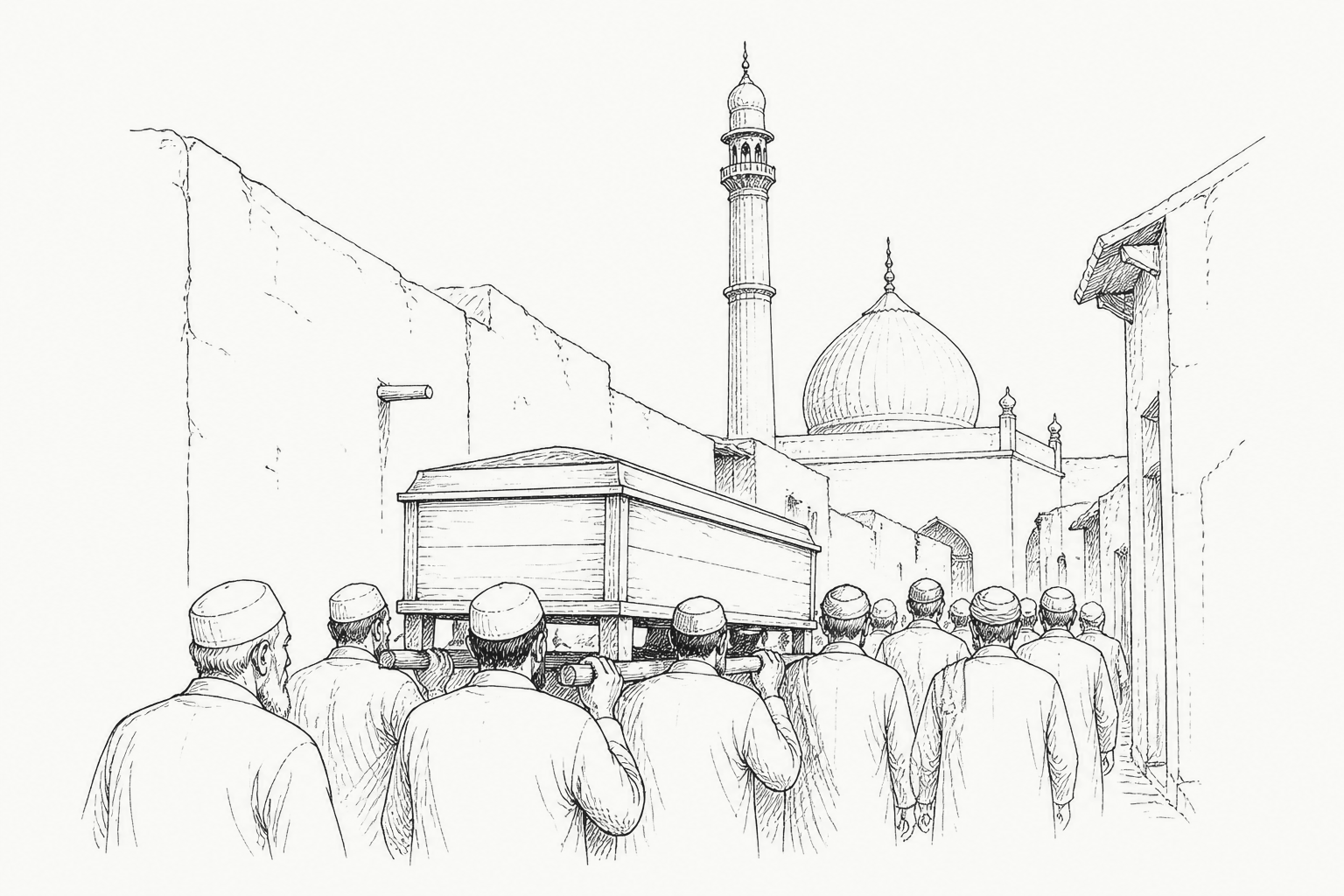
The strikes came as a Mahan Air flight carrying Khamenei's coffin taxied to a stop in Mashhad under Iranian fighter escort. State television aired footage of mourners packing Imam Reza Street as the coffin was carried toward the Holy Shrine of Imam Reza, where it was to be interred alongside relatives killed in the Feb. 28 U.S. and Israeli strike that opened the war. The week-long funeral, which began July 4 in Tehran, had been publicly framed by both governments as a window for reduced tensions and continued talks.
The president
President Trump, returning from the NATO summit in Ankara aboard Air Force One, told reporters that Iran "called a little while ago" seeking a deal. "I say we hit them 20 to 1 – every time they hit us, we're going to hit them 20, and we did it last night," he said, according to CNBC. Asked whether the two countries were headed back to full-scale war, Trump replied, "I don't know," adding that Washington had "already won militarily" and describing the Iranian government as "sort of crazy." Trump had told reporters in Ankara on Wednesday that the June memorandum was "over," but said he would let U.S. negotiators keep meeting the Iranian side. Vice President JD Vance, speaking at an anti-fraud event in Milwaukee, said the choice was simple: "if they shoot at ships, we're going to knock the hell out of them."
The counterpoint
Only center and lean-left outlets carried on-the-record reporting Thursday; no administration officials beyond Trump and Vance had publicly defended the widening campaign by press time, and Iranian assertions that a hospital and civilian rail infrastructure were hit could not be independently verified. Alam Saleh, a professor of politics at the University of Bradford, told Al Jazeera the American approach had reached "a dead end" and that "Bombing is not working."
Oil markets moved little. Brent crude for September delivery held above $78 a barrel and West Texas Intermediate traded at $73.55. Iran's Health Ministry said 47 of the 78 wounded remained hospitalized as Khamenei's burial ceremony began.