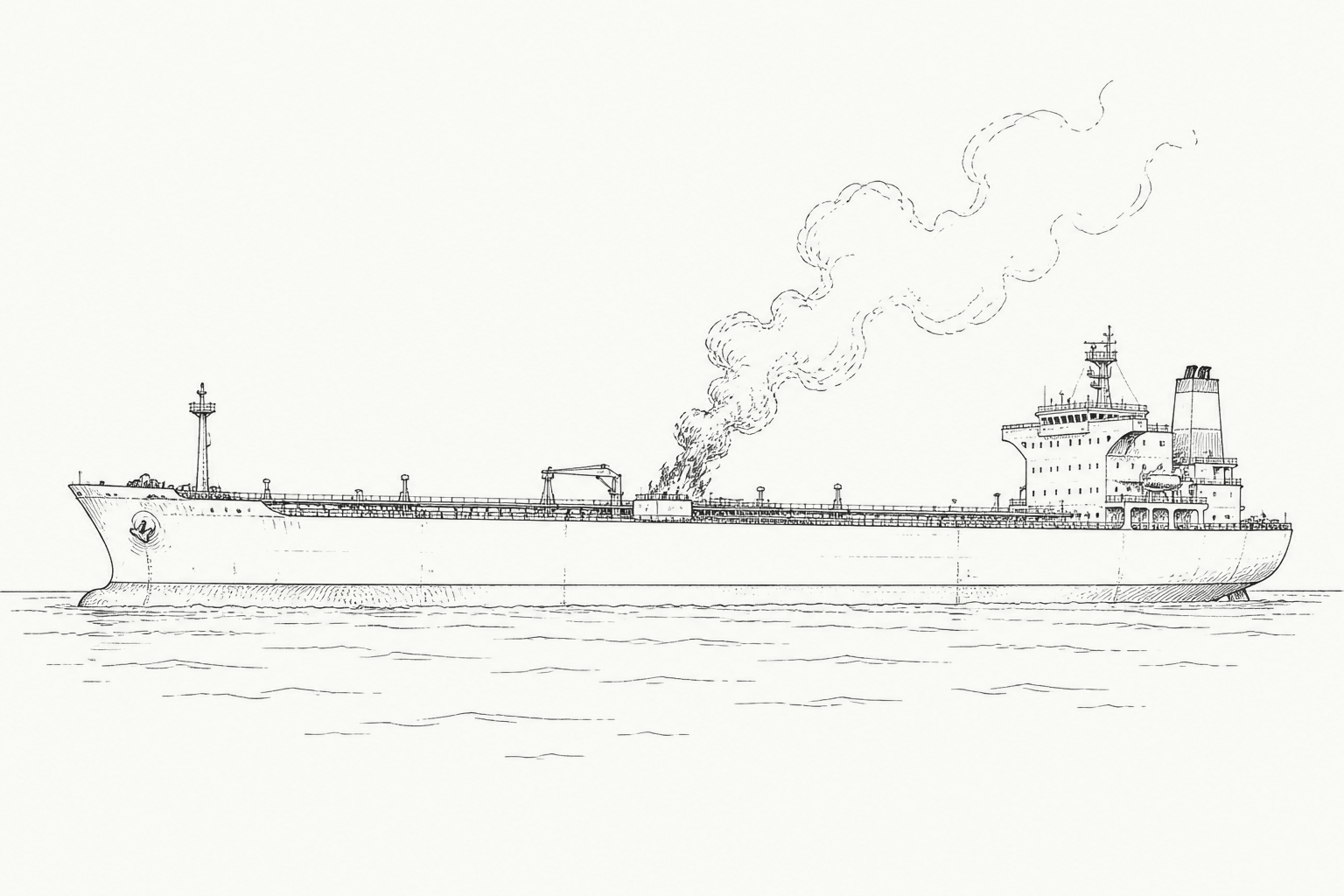
Iran's Revolutionary Guards fired missiles at commercial ships transiting the Strait of Hormuz overnight, striking a Qatari liquefied natural gas tanker and damaging a Saudi-flagged crude oil supertanker on Tuesday and ending a three-week lull in attacks on the world's most important oil chokepoint.
Brent crude jumped and West Texas Intermediate reversed a slide, testing the interim peace agreement that Washington and Tehran signed June 17 to wind down a nearly four-month war that opened Feb. 28 with the U.S.-Israeli strike that killed Ayatollah Ali Khamenei. Indirect talks in Doha broke last week without meaningful progress and paused again for Khamenei's six-day funeral, whose procession moved to Qom overnight.
What was hit
The Al Rekayyat, a Qatari LNG carrier, was hit on its port side and sent distress signals near Oman's coast, the U.K. navy's Maritime Trade Operations center said. A source briefed on the incident told Reuters that fire in the vessel's engine room later put it at risk of exploding. The UKMTO placed the strike 8 nautical miles east of Limah, Oman.
A second vessel, believed to be the Bahri-owned supertanker Wedyan, was damaged off Oman's coast in a separate incident Tuesday, Reuters reported, citing unnamed sources. Iran fired at least two missiles at ships in the strait Monday evening, Axios reported, citing two unnamed U.S. officials, and the vessels sustained significant damage but no casualties. Iranian state television said the LNG tanker was struck after ignoring warnings but did not directly claim the assault. Tehran has repeatedly said only its approved route through the strait is safe.
The price move
Brent futures for September delivery traded 1.2 percent higher at $72.85 a barrel on Tuesday morning, paring earlier gains, CNBC reported. West Texas Intermediate for August delivery rose 1 percent to $69.26 after closing Monday at its lowest level since Feb. 27. About 20 percent of the world's seaborne oil moves through the strait, and container-shipping capacity through the region had already rebounded to pre-war levels on some routes since the June memorandum, according to Xeneta data cited by Al Jazeera.
The diplomatic squeeze
President Trump on Monday said the U.S. would either "make a deal or we're going to finish the job." He added, "I'd rather make a deal, because I don't want to affect 91 million people," and threatened that the U.S. "can knock down their bridges in one hour" and "can knock out their energy supply."
Iranian Foreign Minister Abbas Araghchi answered Tuesday on social media that "Negotiations on final Deal will not commence if threats continue," citing the mid-June memorandum's requirement that both sides "refrain from the threat or use of force against each other." Araghchi did not reference Trump's remarks by name.
Counterpoint
No U.S. official spoke on the record about the strikes by press time in the reports available for this edition, which drew on center and lean-left outlets; conservative wire coverage of the administration's response was not represented. The attribution of the attacks to Iran's Revolutionary Guards rests on unnamed U.S. officials cited by Reuters and Axios, and Iranian state media stopped short of a direct claim. Holger Schmieding, chief economist at Berenberg, wrote to clients Friday that the Strait of Hormuz "remains unsettled" but argued that "both sides should ultimately have an interest in containing the conflict," noting Trump wants low oil prices before November's midterms and the Revolutionary Guards want the money from sanctions relief.
U.S. and Iranian negotiators are due back at the table in Doha next week, with the funeral rites for Khamenei set to conclude Friday.