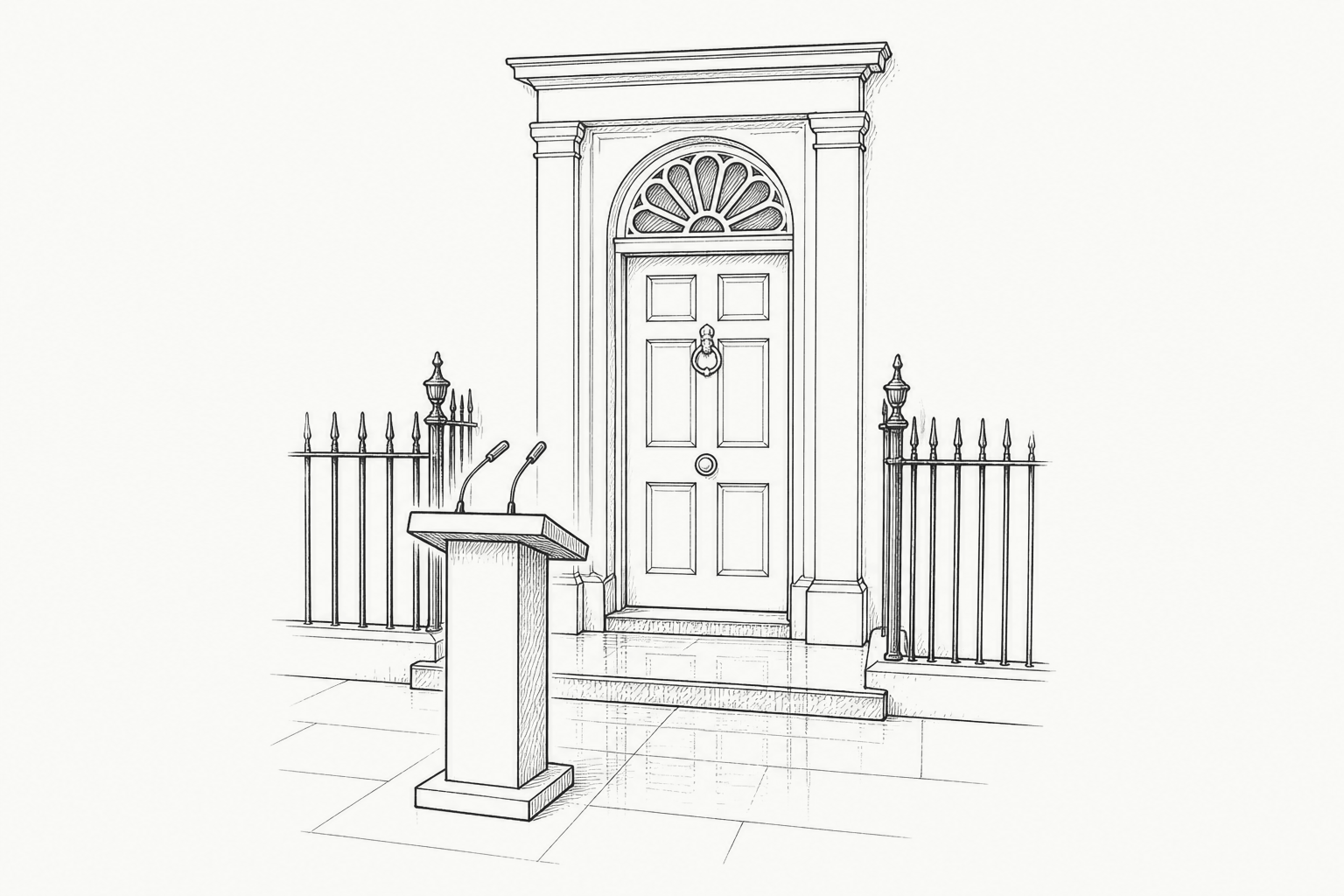
British Prime Minister Keir Starmer announced his resignation Monday outside 10 Downing Street, bowing to a Labour Party revolt that hardened last week after former Manchester Mayor Andy Burnham won a parliamentary by-election in Makerfield and made clear he would challenge for the job. Burnham confirmed his bid hours later, saying the succession should be "conducted in an orderly and responsible way."
Starmer's exit ends a tumultuous premiership less than two years after Labour's landslide victory in 2024 and sets up Britain's seventh prime minister in 10 years. A formal leadership contest is scheduled to begin July 9 and to be completed by Parliament's summer recess, according to Al Jazeera, leaving open whether the party stages a full campaign or settles on Burnham by acclamation.
What Starmer said
Speaking from a lectern outside his official residence, Starmer extolled his time in office before turning to the question his colleagues had been pressing for weeks. "The question my party is asking now is whether I am best placed to lead us into the next election," he said. "I have heard the answer… and I accept that answer with good grace. Every decision I have made has been about putting the country I love first."
"I will resign as leader of the Labour Party," he added, pledging his successor "my full and unequivocal support." CBS News reported that Starmer appeared to choke up toward the end of his remarks as he spoke of his children, whom he called his "pride and joy."
The timetable depends on whether Labour holds a contested vote. CBS reported that Starmer could be out of the premiership by July if the party unites around a single candidate; otherwise the new leader will be chosen by the time lawmakers return from summer recess in September. Al Jazeera said a candidate needs nominations from 81 Labour MPs to make the ballot.
How the revolt built
The Washington Examiner reported that the first serious calls to remove Starmer began in January, after revelations that Lord Peter Mandelson, his ambassador to the United States, had received about $75,000 from convicted sex trafficker Jeffrey Epstein. Mandelson was sacked in September. Pressed in February on whether security vetting had flagged the relationship, Starmer answered "Yes, it did," and said "various questions were put to him."
The May 7 local elections turned discontent into open revolt. Labour shed more than 1,000 local council seats, lost its grip on the Welsh legislature after 27 years in power and recorded its worst Scottish turnout to date, according to CBS and the Washington Examiner. By May 11, more than 60 Labour MPs had publicly called for Starmer to step aside. The populist, anti-immigration Reform UK party, led by Nigel Farage, won nearly 1,300 council seats in England and made gains in Scotland and Wales.
The final straw, the Examiner and CBS both reported, was Burnham's by-election win in Makerfield last week, which returned the so-called "King of the North" to the House of Commons after nearly a decade as Manchester mayor. Defence Secretary John Healey, a Starmer loyalist, had resigned days earlier over the prime minister's military spending plans, followed by armed forces minister Al Cairns. Twenty ministers resigned over the course of Starmer's tenure, CBS reported.
On the markets
The political shock landed in fixed income before it landed at the despatch box. The yield on 10-year U.K. gilts jumped more than 8 basis points to 4.8394 percent on Friday after Burnham's by-election win, as JSJ reported over the weekend. Traders have spent the days since pricing in the risk of a leadership vacuum and an earlier-than-required general election, which under current law is not due until 2029.
The Burnham bet
Burnham, who ran unsuccessfully for the Labour leadership in 2010 and 2015, used his Makerfield acceptance speech to signal his intent. "Everyone knows that politics isn't working," he said, according to CBS. "Everyone can feel that the country isn't where it should be. Tonight could, just could, be the turning point."
Former health secretary Wes Streeting, who had told Politico last week that he wanted a "genuine contest" and would stand as a "plucky underdog," fell in line behind Burnham on Monday. "Having spoken at length with Andy in recent days, I'm convinced that there is a place for those ideas under his leadership," Streeting said in a statement. "We could spend the summer exaggerating small differences, or we can roll up our sleeves and help him to deliver the change our Party and our country needs."
The counterpoint
Reform UK's Farage rejected the premise of an internal handover and demanded an immediate national vote. The British public, he said in remarks reported by the Washington Examiner, have had enough of parties "chopping and changing their leaders at will," and he compared the prospective handover to "a banana republic that has totally devalued the very process of general elections and democracy." "We vote for somebody in a general election to be our prime minister," Farage said.
Labour is under no legal obligation to call an election before 2029, and the Examiner reported that party officials hope to use the intervening period to rebuild before going to the country.
The leadership contest opens July 9. If a single candidate clears the 81-MP nomination threshold uncontested, Britain could have a new prime minister within weeks.