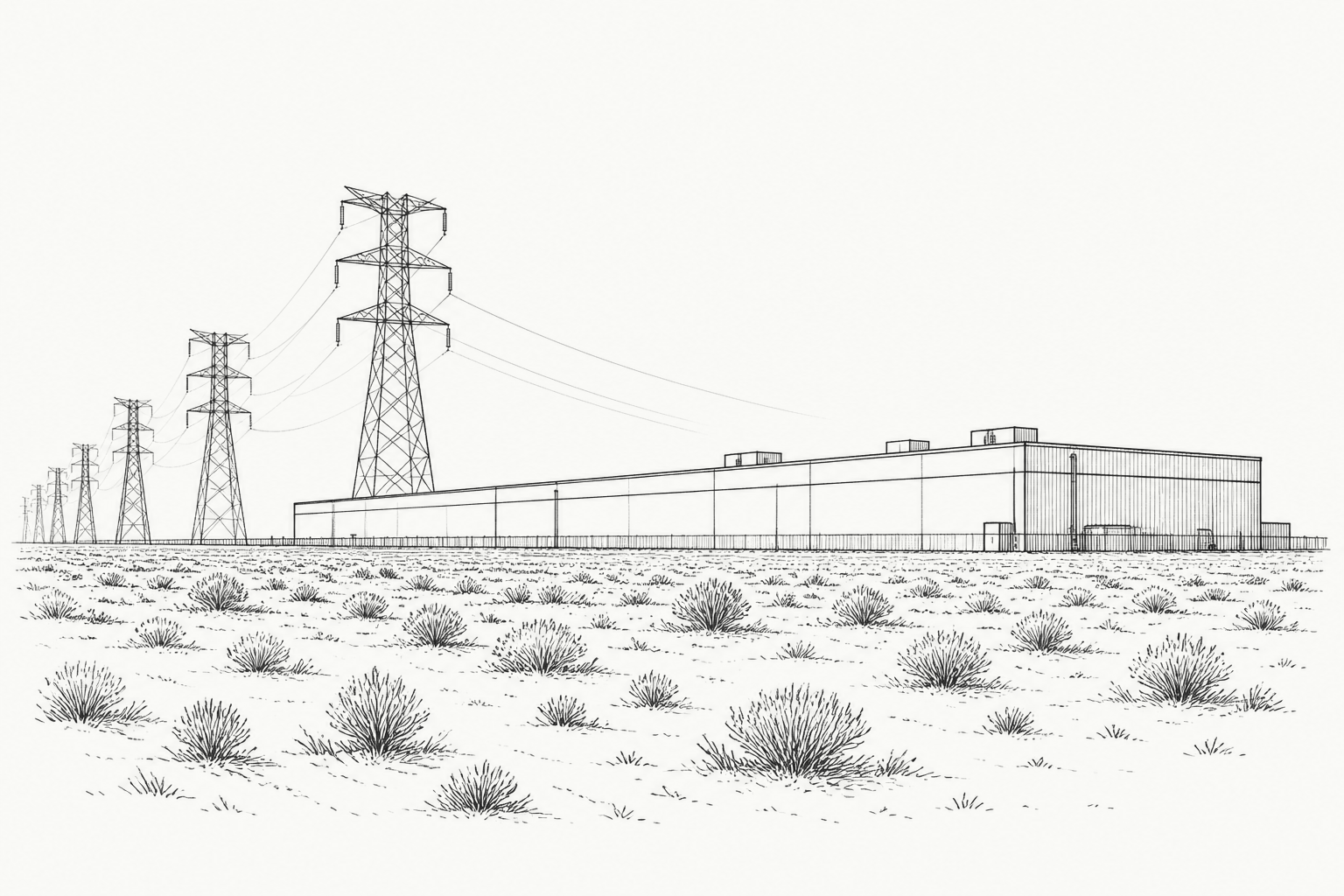
The political fight over artificial-intelligence data centers reached two milestones Monday. A new survey from Milltown Partners, a global public affairs firm that counsels leading AI labs, found nearly half of registered voters support a temporary ban on data-center construction, even though only a small fraction of opponents live near one. Hours earlier, Chevron announced a 20-year agreement to fuel a Microsoft data center in West Texas with natural gas, a project expected to draw nearly 2.7 gigawatts of electricity, roughly the power consumption of 2 million homes.
The two announcements arrived at opposite ends of the same problem. Public tolerance for the AI build-out is narrowing just as the deals required to power it are getting larger, more fossil-fuel intensive and longer in duration.
What the poll found
Milltown surveyed 6,872 registered voters between May 10 and May 20 from online panels, with a margin of error of 3 percentage points. Outright opposition to data centers is not yet a majority view, but the firm found that proximity to a facility has little bearing on whether respondents object to one. Pew Research Center reached a similar conclusion in an April poll, finding that living near an existing or planned data center has little effect on Americans' views.
Axios, which received the Milltown findings first, described the warehouses as a "physical symbol of wider AI anxiety" and noted that warnings from tech executives about AI-driven job loss are handing critics more ammunition. Steve Bannon on the right and Sen. Bernie Sanders on the left have both attacked AI as a threat to working people, an unusual left-right convergence on a single industry.
Project Kilby
Chevron's Texas project, called Project Kilby, has not begun construction in Reeves County. The oil major said it expects to make a final investment decision this year, with power deliveries starting in 2028. A majority of the electricity will come from large gas turbines supplied by Chevron's partner GE Vernova, with additional turbines from Caterpillar. The power infrastructure will sit at the data center site rather than on the broader Texas grid.
Microsoft has invested primarily in renewable energy and, more recently, nuclear power to offset emissions from its data centers. The Chevron contract marks a shift. CNBC characterized the deal as evidence that the tech giant is "willing to invest in a fossil fuel to meet the growing power demand from its data centers."
The missing voice
Industry trade groups had not publicly responded to the Milltown survey by Monday afternoon, and the dataset has not yet been independently reviewed. A consulting firm whose clients include the largest AI labs is also an unusual messenger for findings that argue for a construction pause, a tension the firm has not addressed in its public release.
The Texas deal will face its own test this year, when Chevron's board decides whether to commit capital. A final investment decision would lock in two decades of gas-fired generation for a single hyperscaler at a moment when nearly half the country, by Milltown's count, wants the build-out to stop and catch its breath.