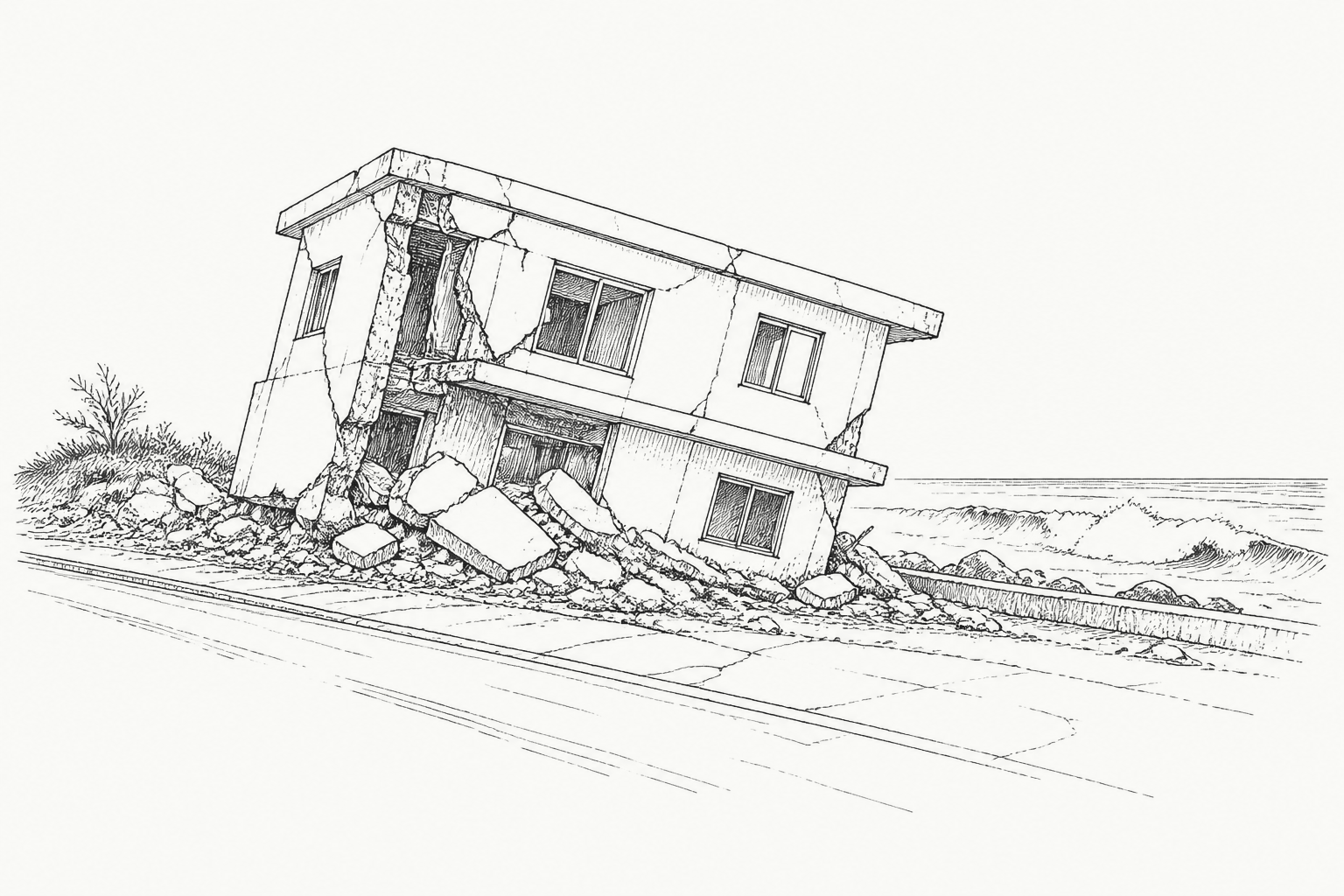
DAVAO, Philippines — A magnitude 7.8 earthquake struck off the southern Philippine island of Mindanao at 7:37 a.m. Monday, killing at least 32 people, injuring more than 200 and sending a one-meter tsunami into nearby coasts, Philippine officials said. President Ferdinand Marcos Jr. canceled school nationwide and ordered disaster-response agencies into the worst-hit provinces.
The quake was the strongest to hit the Philippines this year, collapsing low-slung buildings in the tuna-export port of General Santos, setting off a landslide that buried 13 villagers in mountainous Glan and pushing waves as far as Indonesia, Palau and southern Japan. It was the deadliest Philippine quake since one on Cebu killed 74 people last year.
The toll
Thirteen of the dead were villagers in the town of Glan, in Sarangani province, where a landslide triggered by the shaking struck their houses, Rene Punzalan, a provincial disaster-mitigation official, told the DZBB radio network. Four other people died in Sarangani for reasons still being determined, Punzalan said. Seven were killed in General Santos, where small buildings, including a hamburger restaurant, collapsed or sustained heavy damage, according to Rod Sosmeña, regional director of the Office of Civil Defense. The remaining deaths were caused by falling debris, a damaged mosque and a landslide across South Cotabato, Davao Occidental and Balut Island.
At least 12 people were missing in General Santos, a city of more than 700,000, where rescue teams searched a collapsed supermarket, a warehouse and a two-story school. Public schools had reopened nationwide Monday after the April-to-May summer break, and more than 100 students attending morning flag-raising ceremonies in the Davao region sustained bruises or fainted in panic, regional disaster-response official Ednar Dayanghirang told The Associated Press.
The shaking
The quake was centered at sea about 20 miles southwest of Maasim town in Sarangani at a depth of roughly 20 miles, said Teresito Bacolcol, director of the Philippine Institute of Volcanology and Seismology. The U.S. Geological Survey put the depth at 34 miles, a routine early-data discrepancy.
"Our pickup truck suddenly jerked and I thought we had a flat tire," Sosmeña told the AP from General Santos. "The shaking was very strong and people dashed out of houses into the streets." Dayanghirang said he could "hardly stand and keep my balance when the ground shook as I was leaving my house" in Davao. Benjie Ancheta, the police chief of Alabel in Sarangani, told Reuters his station building cracked during a flag-raising ceremony. "This is the strongest earthquake we've experienced," Ancheta said.
Tsunami and infrastructure
The Pacific Tsunami Warning Center said the tsunami threat had largely passed about five hours after the quake, and Philippine officials lifted their own warning by mid-afternoon. Waves of one meter were recorded along the coasts of Sultan Kudarat and Sarangani, and a 1.4-meter wave hit Kiamba town at one point, Bacolcol said. An 83-centimeter wave was measured off Indonesia's Sulawesi island; 30-centimeter waves reached Palau; and waves of up to 20 centimeters were detected on the remote Japanese island of Chichijima, the Japan Meteorological Agency said.
General Santos international airport was temporarily shut and 17 domestic flights were canceled, the Civil Aviation Authority of the Philippines said. A four-story commercial building housing the provincial station of Manila's DZRH radio network partly collapsed; staffers escaped without injuries.
Marcos response
"The national government is moving and we will not leave Mindanao behind," Marcos said, canceling classes and directing disaster agencies to deploy. The United States, a treaty ally, said it was coordinating with Manila and stood ready to assist; France and New Zealand also offered support. Marcos urged residents to "heed the tsunami warning" and move to higher ground.
The risk is not over. The seismology agency recorded as many as 138 aftershocks after the initial jolt, including tremors as strong as magnitude 6.5, and Bacolcol warned residents to seek advice before returning to damaged buildings, which could collapse in further shaking. With 12 people still missing in General Santos alone, the casualty count is likely to rise as crews reach buried structures and remote landslide sites.
The Philippines sits on the Pacific Ring of Fire, an arc of seismic faults that also subjects the archipelago to about 20 typhoons a year.