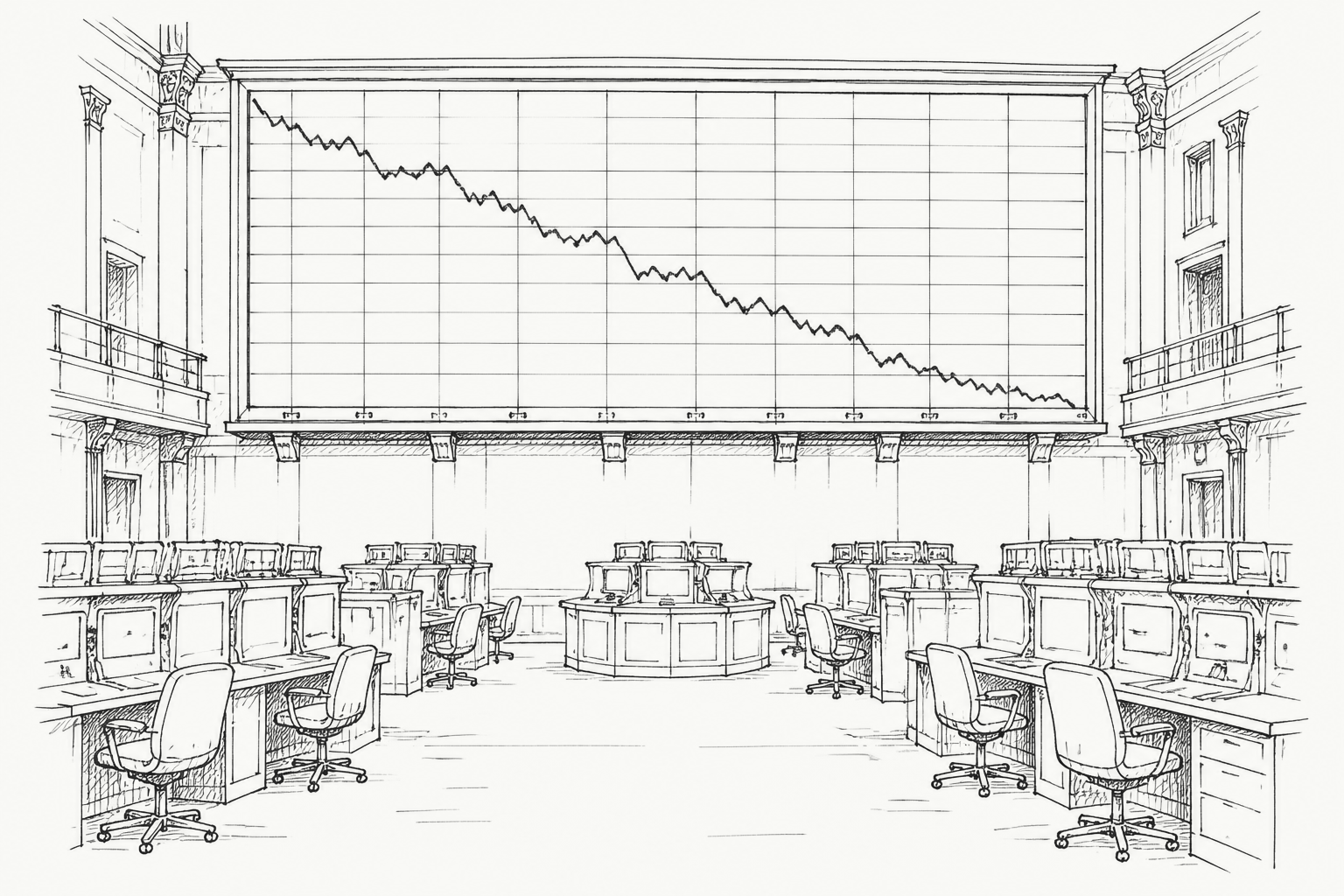
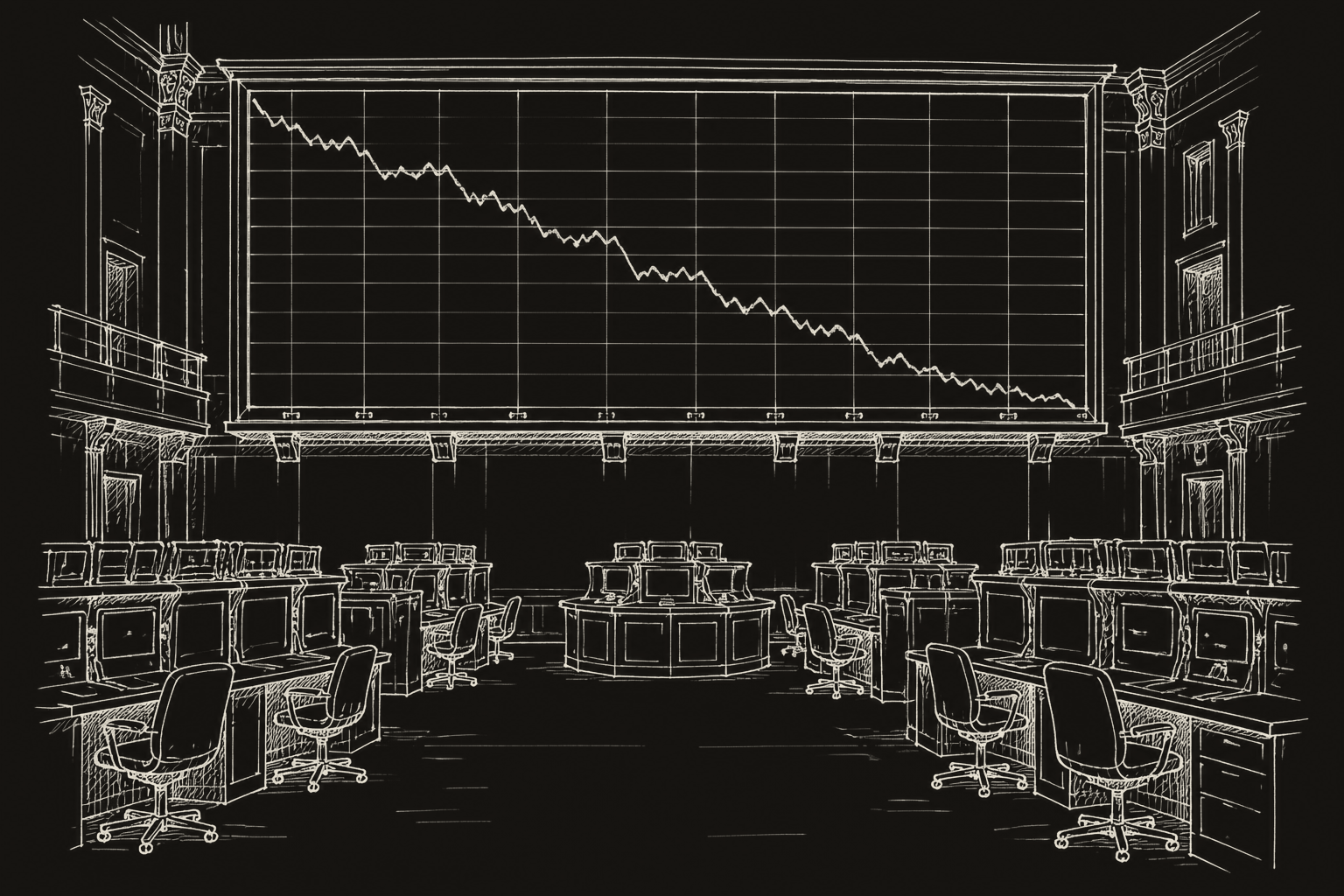
South Korea's KOSPI closed down 8.29 percent Monday after a morning plunge of nearly 9 percent tripped the Korea Exchange's circuit breaker for the second time this year, the sharpest leg of a global sell-off that turned Friday's U.S. payrolls shock into a synchronized exit from the AI trade.
The move made 2026's best-performing major index the day's biggest loser. Samsung Electronics fell 10.2 percent and SK Hynix 7.6 percent, Japan's Nikkei 225 dropped 3.9 percent, and Taiwan's TAIEX slid 3.5 percent. Brent crude rose 3.7 percent to top $88.50 a barrel as Israel and Iran traded fire for the first time since April, layering a geopolitical premium onto a market already pricing out Federal Reserve rate cuts.
What changed
Friday's payrolls report showed 172,000 jobs added in May against a Dow Jones consensus of 80,000; this paper led Saturday with the line that the print had flipped the Fed bet from cut to hike. The Nasdaq Composite fell 4.18 percent for its worst session since April 2025, and Asia opened Monday to forced unwinds in the chip names that had carried the year.
"The sharp declines have been triggered by the large correction in US tech last Friday following the blowout numbers on non-farm payrolls," Fabien Yip of IG Group told Al Jazeera, citing "fading optimism on the AI trade, particularly affecting picks-and-shovels tech companies in Asia."
Forced sellers
Foreign investors had sold a net 1.24 trillion won, about $801 million, of KOSPI shares by 11 a.m. Singapore time, according to Korea Exchange data cited by CNBC. Goldman Sachs put cumulative net foreign outflows at roughly $62 billion as of late May.
Strategists framed the selling as mechanical, not fundamental. "This is essentially forced selling that we are seeing from our investors and clients," Chetan Seth, Nomura's Asia-Pacific equity strategist, told CNBC, citing index-weight increases that have pushed active managers against portfolio limits. Nick Wilcox of Man Group said "A lot of the selling is forced selling because investors are coming up against active limits."
The hyperscaler bear case
Jim Cramer, in a CNBC column Sunday, wrote he was abandoning his bull stance because the AI buildout no longer offered a visible payoff, and because Alphabet's $80 billion equity raise signaled Amazon, Microsoft and Meta might have to follow. The hyperscalers, Cramer wrote, "are now at the epicenter of the bear case." He argued data-center costs had risen sharply across labor, materials, power and site development, and that the market could not absorb the equity the largest tech companies would need to issue. The argument is one columnist's view, not a consensus call.
The other side
Cramer ended his column describing his posture as a "chastened bull, not an aggressive bear," arguing the largest platforms cannot afford to stop spending. Goldman Sachs raised its 12-month KOSPI target to 12,000 Friday, forecasting 37 percent upside and calling the foreign-flow picture structural. U.S. hyperscaler executives had not responded by press time.
SpaceX prices its IPO Friday in the largest listing ever recorded, the next test of whether public investors will fund the AI capital cycle.