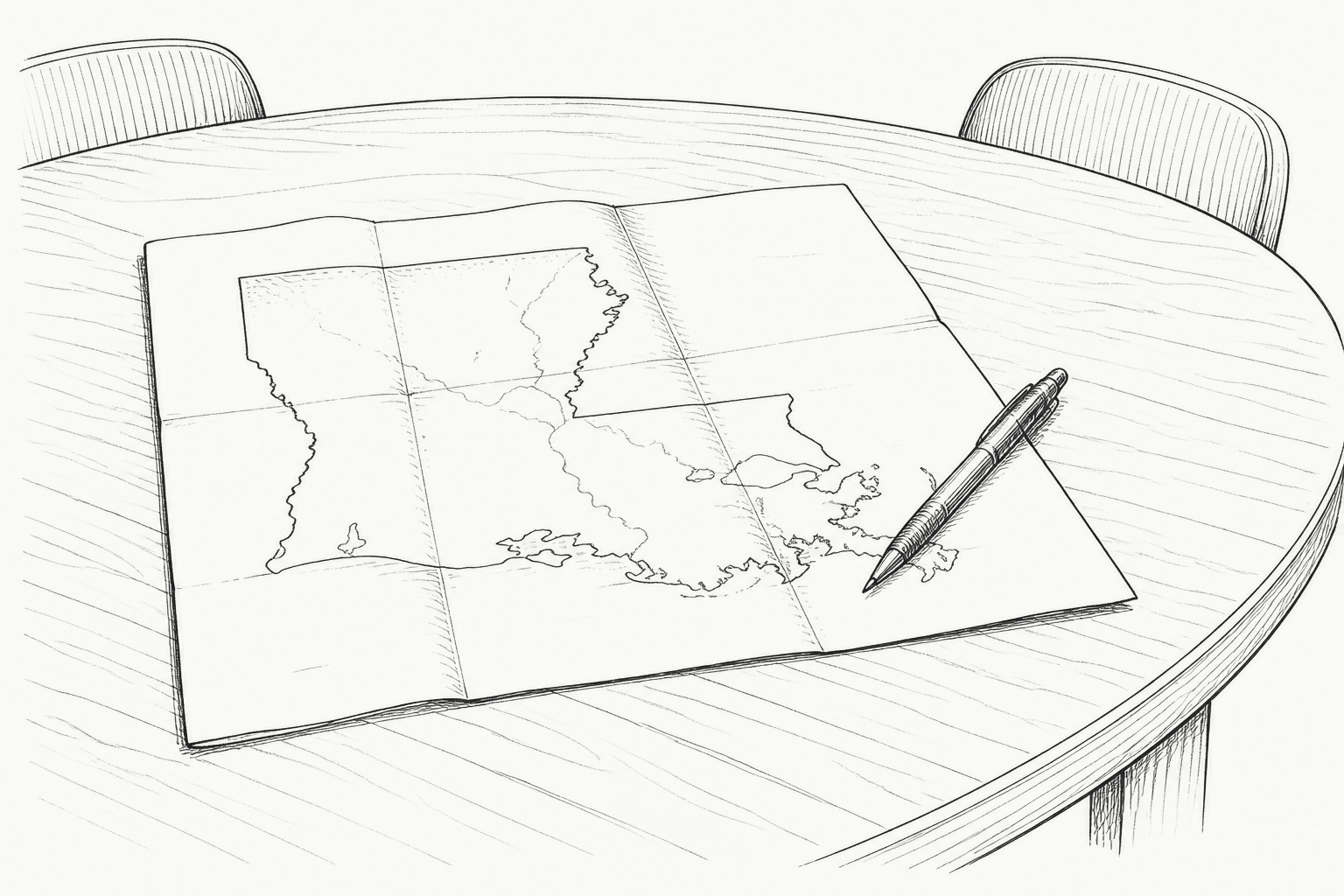
BATON ROUGE, La. — The Louisiana state Senate on Friday passed a new congressional map that eliminates one of the state's two majority-Black House districts and clears a path for Republicans to capture a fifth of the state's six U.S. House seats. The vote was 28 to 10.
The map redraws Democratic Rep. Cleo Fields' district to cluster predominantly white communities in Baton Rouge and southern Louisiana, and folds part of Baton Rouge into the heavily Democratic, majority-Black district held by Democratic Rep. Troy Carter. Republican Gov. Jeff Landry, who postponed the May 16 primary to give lawmakers time to draw new lines, is expected to sign the bill. Republicans currently hold four of Louisiana's six House seats.
Sponsor's defense
Republican state Sen. Jay Morris, the bill's sponsor, said party affiliation, not race, guided the redistricting. "I purposely put more Democrats into District 2 to make the remaining districts better performing for Republicans," Morris said on the floor. He told colleagues he instructed map demographers to avoid including racial data in materials shared with lawmakers before the vote.
Democratic objections
Democratic state Sen. Sam Jenkins called the proposal "a racially gerrymandered district that's going to get us into a lot of trouble here." Morris answered: "Agree to disagree."
Democratic state Sen. Royce Duplessis told the chamber: "From the beginning of the process, I said we're building a house on a broken foundation — now it feels more like quicksand." Duplessis said Louisiana was engaged in "a vicious, vicious race to the bottom" by redrawing districts in the middle of an election year.
Court backdrop
The vote follows the Supreme Court's April ruling in Louisiana v. Callais, which struck down the state's previous map as an illegal racial gerrymander because it contained two majority-Black districts. That decision weakened protections under the 1965 Voting Rights Act and forced lawmakers back to the drawing board within weeks of the scheduled primary.
Legal threats
Morris and other Republicans framed the new boundaries as a partisan exercise insulated from race-based challenges. The American Civil Liberties Union signaled it could sue, describing the map as "a racial gerrymander hiding behind the thin veneer of partisanship." The group added, "This fight is just beginning."
Litigation is expected from multiple quarters once Landry signs the bill. Republican lawmakers argued the Callais ruling gives them room to prioritize partisan performance over demographic balance, and Morris repeated on the floor that demographers were kept away from racial statistics by design.
With Landry's signature, the map would take effect for the rescheduled primary and set up a federal court fight over whether a map drawn for partisan advantage can stand when its practical effect is to dismantle a majority-Black seat that two federal courts previously ordered the state to create.