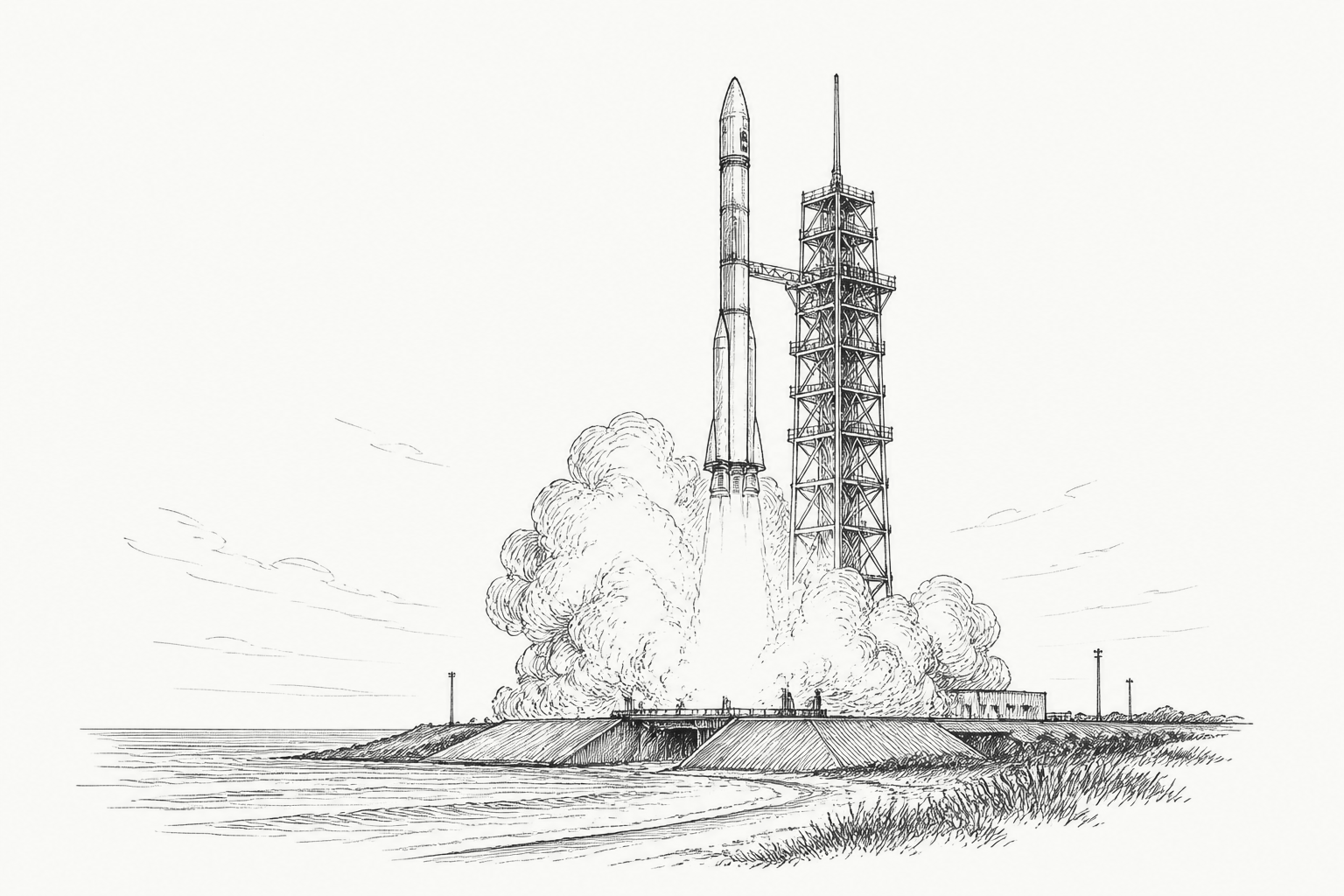
Blue Origin's New Glenn rocket exploded in a fireball at Cape Canaveral on Thursday night during a hot-fire test of its seven first-stage engines, destroying the vehicle and gutting its only launch complex roughly a week before a planned fourth flight.
The blast lands two days after NASA Administrator Jared Isaacman announced a $188 million Moon Base contract for the Jeff Bezos-owned company and called it a central partner in the Artemis program to return American astronauts to the lunar surface in 2028. The same New Glenn variant was to launch Blue Origin's cargo lunar lander later this year and to support an Artemis rendezvous-and-docking test in 2027.
What happened
The explosion occurred around 9 p.m. EDT at Launch Complex 36 at Cape Canaveral Space Force Station as engineers counted down to a brief firing of the rocket's methane-fueled BE-4 first-stage engines, CBS News reported. The 188-foot first stage became enveloped in flame at its base, the 86-foot upper stage tilted as the booster collapsed, and the vehicle's methane and liquid oxygen ignited in a single blast visible for miles. The 48 Amazon Leo internet satellites the rocket had been preparing to carry in June were not on board.
The U.S. Space Force Eastern Range said all personnel were accounted for and no one was injured. Brevard County Emergency Management called the event an "anomaly" that posed "no threat to the general public." Helicopter video showed multiple fires on the pad, no sign of the erector-gantry used to raise the rocket vertical, and at least one of two lightning towers missing.
Why it matters
Blue Origin operates only one New Glenn pad, the one damaged Thursday. After a SpaceX Falcon 9 exploded on the adjacent Pad 40 in September 2016, the last on-pad failure at the Cape, that complex was out of service for more than a year, CBS noted. SpaceX kept flying from a second Florida pad and from California. Blue Origin has no such backup.
That asymmetry matters for NASA. The agency's 2027 Artemis mission calls for a rendezvous-and-docking exercise in low-Earth orbit using moon landers built by SpaceX and Blue Origin, with one or two crewed landings in 2028. Blue Origin had planned to launch a cargo version of its lander on New Glenn before year-end as a rehearsal. Tuesday's broader Moon Base award also hired Firefly Aerospace alongside Blue Origin to pre-stage landers, rovers and drones at the lunar south pole.
The responses
"All personnel are accounted for and safe," Bezos wrote on X. "It's too early to know the root cause but we're already working to find it. Very rough day, but we'll rebuild whatever needs rebuilding and get back to flying. It's worth it."
Isaacman said NASA was aware of the incident and would "provide information on any impacts to the Artemis and Moon Base programs as it becomes available." He added: "Spaceflight is unforgiving, and developing new heavy-lift launch capability is extraordinarily difficult."
SpaceX founder Elon Musk, whose Falcon 9 and Starship vehicles are the direct competitors to New Glenn, replied to Blue Origin's post: "Sorry to see this, I hope you recover quickly." In a separate post quoted by CNBC he wrote, "Most unfortunate. Rockets are hard."
Track record
New Glenn has flown three times. On its April flight, an upper-stage malfunction prevented a commercial internet satellite from reaching its planned orbit, CBS reported. The Federal Aviation Administration later cleared the rocket to resume flights. The destroyed June mission was to begin Amazon's deployment of the Leo broadband constellation, a direct competitor to SpaceX's Starlink.
What's next
Neither Blue Origin nor the FAA has identified a cause; investigators will rely on telemetry and pad video. The Eastern Range said it remains fully mission-capable for launches from other complexes. Neither body-tier account Thursday night raised pointed criticism of Blue Origin or of NASA's reliance on it, and administration officials beyond Isaacman had not publicly addressed whether the destroyed pad will push NASA to lean harder on SpaceX for the 2027 docking test. Blue Origin has not said how long the rebuild will take.