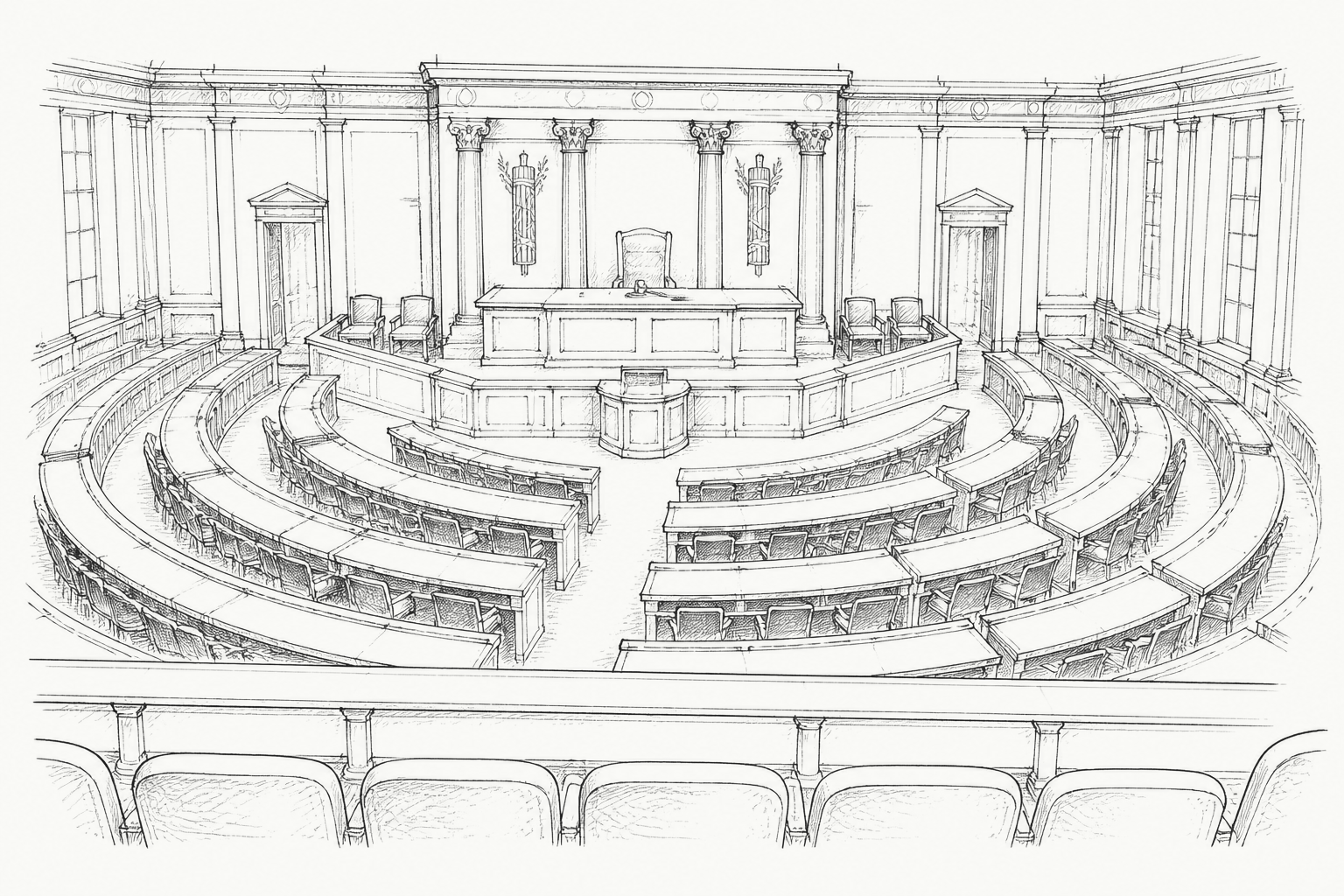

House Republican leaders on Thursday pulled a Democratic war powers resolution to halt U.S. military operations against Iran, after a head count showed the measure had the votes to pass. The cancellation pushes the vote to June 2 and came as Secretary of State Marco Rubio, in Sweden for a NATO foreign ministers meeting, rejected Iran's bid to impose tolls on commercial traffic through the Strait of Hormuz and reported slight progress in the peace track Pakistan’s army chief, Field Marshal Asim Munir, opened in Tehran this week.
The twin moves shifted the war's center from the Gulf to Washington and Stockholm. The delay gives Trump 11 more days of unchecked authority while negotiators work the Pakistani channel. The Hormuz tolls standoff has become the second-hardest issue after Iran's enriched uranium stockpile, straining the uneasy ceasefire still in effect.
The vote that wasn't
The resolution, sponsored by Rep. Gregory Meeks of New York, would have directed the president to remove U.S. forces from hostilities against Iran except where needed to defend the United States or an ally from imminent attack. A similar measure failed on a tie in the House last week, with three Republicans crossing over; Rep. Jared Golden of Maine, the only Democrat opposed, said he would switch his vote this time. House Majority Leader Steve Scalise told NBC News some members “weren’t there for it who wanted to be recorded on it” and would get that chance in June. House Minority Leader Hakeem Jeffries and other Democratic leaders called the move “cowardly” in a joint statement, and Rep. Jim McGovern of Massachusetts said on the floor that Republicans did not “have the guts or the balls to vote on this”.
The war, which Trump launched on Feb. 28 without congressional authorization, has killed at least 13 U.S. service members, wounded hundreds and cost $25 billion, per Pentagon figures cited by NBC. The administration argues the 1973 War Powers Resolution does not apply because a ceasefire is in effect, and NBC reported the Pentagon is weighing renaming the campaign “Operation Sledgehammer” from “Operation Epic Fury” — a move that could be used to argue the 60-day clock has restarted. A parallel Senate resolution advanced 50-47 on Tuesday.
The tolling fight
In Sweden, Rubio pushed a draft U.N. Security Council resolution tabled by Bahrain that demands Iran stop attacks on shipping, end the placement of sea mines and abandon any attempt to charge vessels for passage. Rubio said the draft had "the highest number of co-sponsors of any resolution ever" at the council but that "a couple of countries" were considering vetoes. "That would be lamentable", he said, adding: "Let's see if the United Nations still works." China and Russia vetoed a similar Bahraini text last month.
"That's just not acceptable. It can't happen," Rubio said of the tolling plan. "If that were to happen in the Straits of Hormuz, it will happen in five other places around the world." Trump, asked Thursday about reported Iran-Oman discussions on a payment mechanism, told reporters his administration had "total control" of the waterway. "We want it open. We want it free. We don't want tolls. It's international. It's an international waterway," the president said, per CNBC.
Iran's semi-official Tasnim news agency said Friday that 35 vessels transited the strait in the previous 24 hours under coordination with the Islamic Revolutionary Guard Corps. CBS News could not confirm the figure; the U.K. Maritime Trade Operations center logged 13 transits over the prior 48 hours, against a pre-war norm of roughly 138 a day. MarineTraffic data showed the Cook Islands-flagged tanker Pushpak anchored off Duqm, Oman, after exiting the strait.
What Tehran said
Iran's semi-official Iranian Students' News Agency said the latest U.S. proposal, delivered through Pakistan, has "narrowed the gaps to some extent," but warned further movement requires Washington to drop "the temptation for war". "There's been some slight progress," Rubio told reporters. "I don't want to exaggerate it, but there's been a little bit of movement, and that's good." Supreme Leader Mojtaba Khamenei this week issued a directive, reported by Reuters and cited by CNBC, ordering that near-weapons-grade uranium not be sent abroad — a flat rejection of the central U.S. demand.
Rubio also said Venezuelan Acting President Delcy Rodriguez will travel to India next week to discuss crude sales, parallel to his own May 23-26 visit to New Delhi. Venezuelan shipments to India ran at about 417,000 barrels a day so far in May, up from 283,000 in April, per Kpler data, as Saudi cargoes to India nearly halved to roughly 340,000 barrels a day.
The counterpoint
Iran rejects the premise that tolling is illegitimate. Its U.N. ambassador, Amir Saeid Iravani, called the Bahraini draft "deeply flawed, and one-sided", and a senior Iranian official wrote Thursday that a "fundamental change of circumstances" gives Tehran the right to impose restrictions as a coastal state. Today's sources do not include a right-leaning U.S. outlet, leaving the domestic hawkish case against any deal unrepresented here.
The Senate's war powers resolution faces a final vote in the coming days; the House version returns June 2. The Security Council is expected to take up the Bahraini draft within the week. Rubio lands in New Delhi on Saturday.