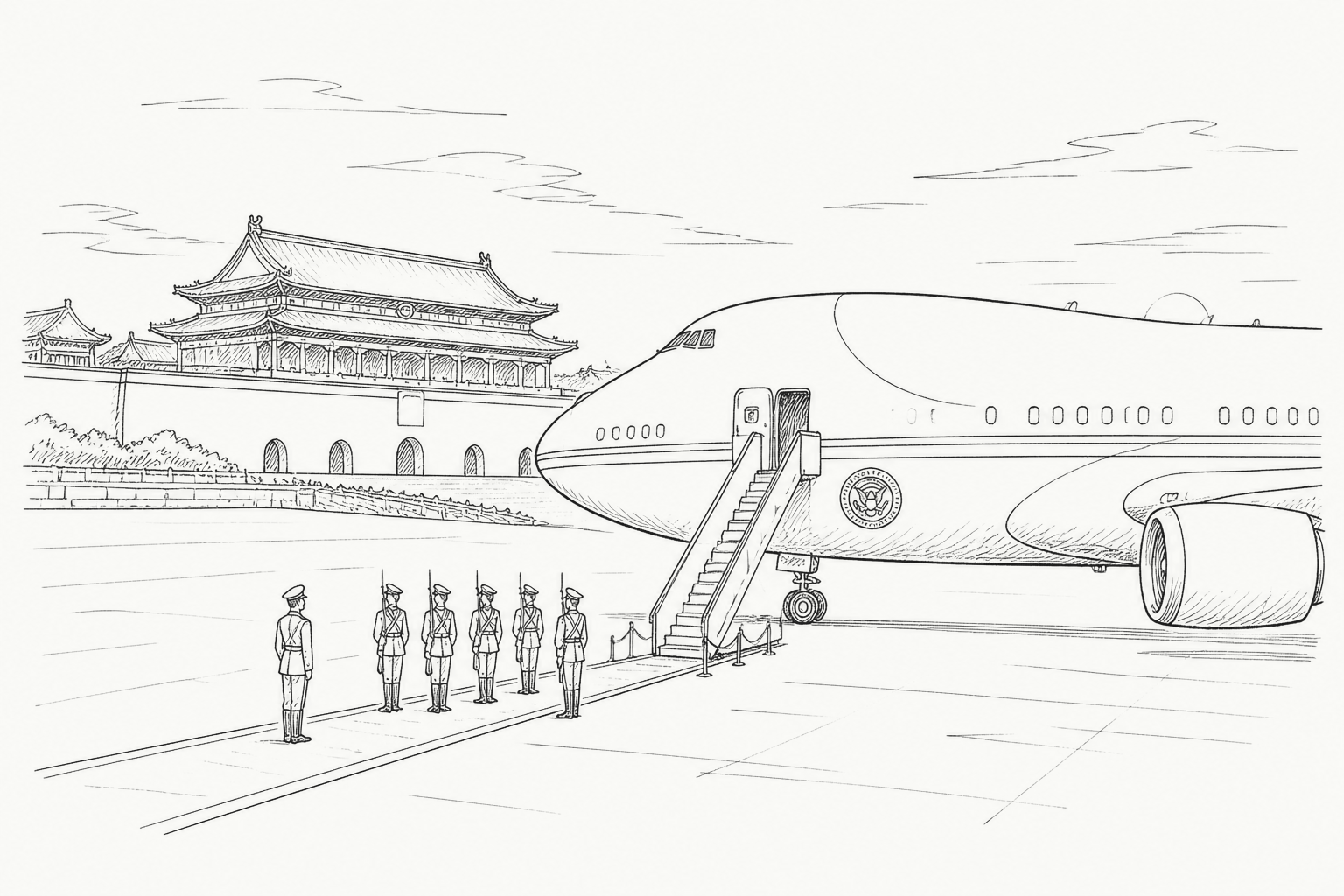
President Trump arrived in Beijing on Wednesday evening with a delegation of American chief executives in tow, opening a three-day state visit in which expected deliverables include a Boeing order, agricultural purchases and the fate of a $14 billion U.S. arms package for Taiwan that still needs his signature.
The CEO contingent, an unusual feature of a presidential state visit, signals that the administration plans to convert Thursday's and Friday's sit-downs with Chinese President Xi Jinping into concrete commercial announcements rather than a communique. The headline question is whether Trump, in exchange for the investment numbers he has said he wants, gives ground on the Taiwan arms sale or on the tariff and export-control architecture Washington has tightened over two years.
What is new today
This paper reported Tuesday that Trump would land in Beijing for a Wednesday-to-Friday visit, his first trip to China since November 2017. PBS NewsHour correspondent Nick Schifrin, reporting from Beijing, said the scale of the executive contingent traveling with the president is itself the news. "President Trump will come here with CEOs. That hasn't happened in decades," Schifrin reported.
Sean Stein, president of the U.S.-China Business Council, told PBS NewsHour that the U.S. side is pushing announcements on a proposed "Board of Trade" and "Board of Investment" and that the two governments are expected to unveil deals on Boeing jets and on American beef and pork at or shortly after the summit.
"When the two presidents talk, good things happen," Stein said.
The trade box
Feng Chucheng, a founding partner of Beijing-based Hutong Research, told Al Jazeera that Xi is likely to agree to step up purchases of U.S. agricultural exports and Boeing planes and could back Trump's plan to create the two boards to oversee bilateral economic ties. China is unlikely to compromise on rare-earth magnets, where it holds a near monopoly, absent "major political concessions" from Washington, Feng said.
Beijing's broader ask is durability. "Beijing wants predictability and certainty for the remainder of Trump's term through January 2029, because Beijing needs to be able to plan its own economic policies," Feng told Al Jazeera. The two leaders agreed in Busan, South Korea, in October to a one-year tariff reprieve while leaving certain duties and export controls in place.
Taiwan and Iran
The $14 billion arms package for Taiwan that Congress approved earlier this year still requires Trump's final sign-off, Al Jazeera reported, and the president said this week that arms sales to the island would be on the summit agenda. Chinese Foreign Minister Wang Yi told Secretary of State Marco Rubio last month that Taiwan is "the biggest risk in the China-US relationship," according to a Chinese readout cited by Al Jazeera. China's embassy in Washington named Taiwan as the first of "four red lines" that "must not be challenged" after Trump's Tuesday departure.
On Iran, Trump shifted positions before takeoff. He said first that he and Xi would have a long talk about the war, then that he does not need Chinese help, then that Xi had been "relatively good" about Iran, according to PBS NewsHour. China buys more than 80 percent of Iran's oil and has called for a comprehensive ceasefire since the war began.
The counterpoint
The case that Trump arrives with leverage runs through the same PBS reporting. Schifrin said the U.S. could raise tariff rates that have been reduced, has maintained export restrictions on semiconductors and remains China's single largest trading partner, while the Chinese economy "faces serious headwinds." Fox News columnist Alexander Grey argued Wednesday that "Trump heads to China with the upper hand — and Xi knows it."
Stein offered the rebuttal in the same PBS segment. China has weathered the tariffs with less damage than Beijing initially feared, has grown more self-sufficient in technology despite U.S. export controls and has its own leverage in rare earths, he said, and the "America hawks' voice is growing louder" inside the Chinese system.
The formal sessions begin Thursday in Beijing. The investment number Trump demands, and what he is prepared to trade against it on Taiwan, tariffs and chips, will be answered by Friday.