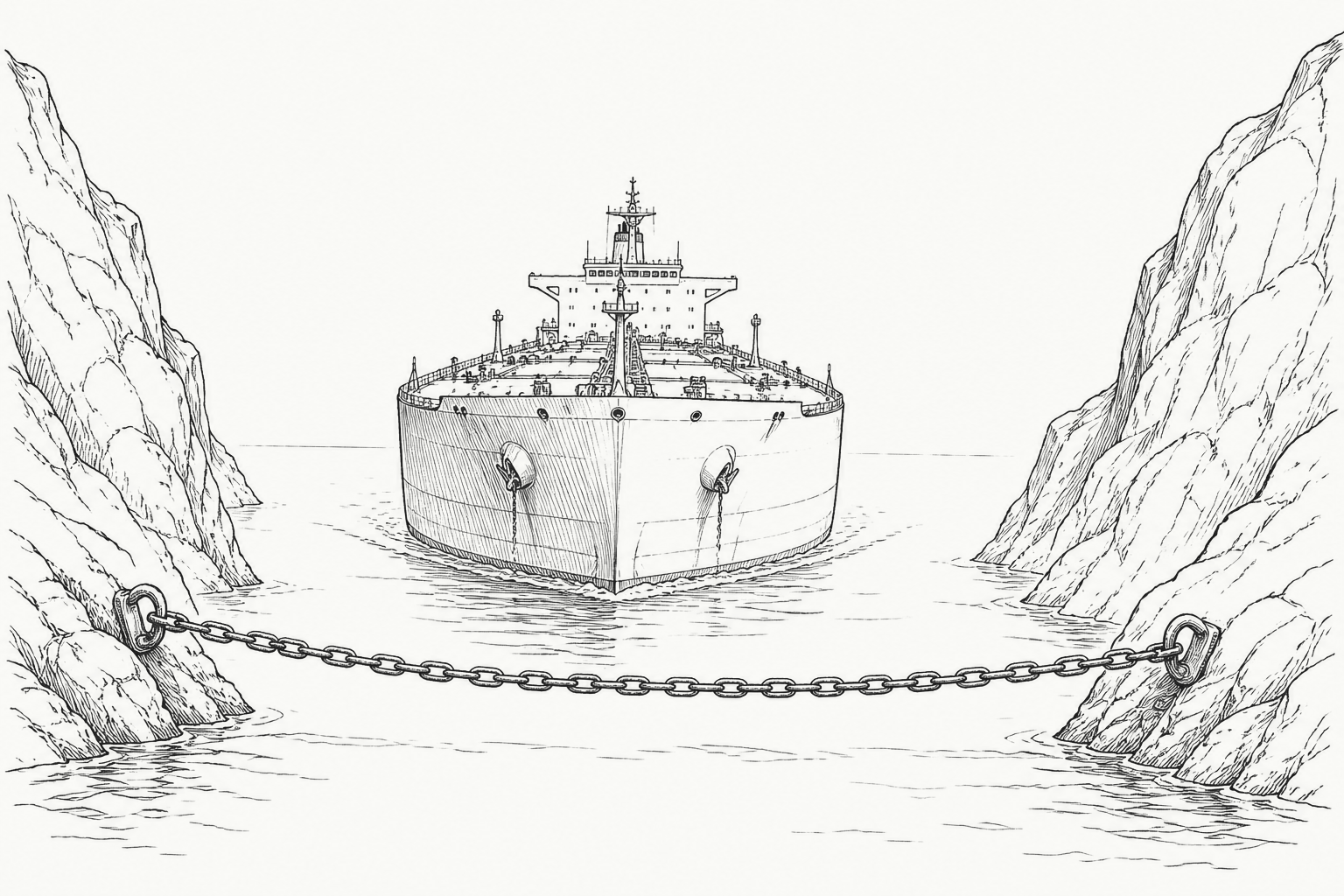
Iran has offered the United States a deal to reopen the Strait of Hormuz and end the two-month war if Washington lifts its naval blockade of Iranian ports, but proposes postponing talks over its nuclear program to a later stage, two officials told CBS News on Monday. The proposal, first reported by Axios, was passed to the Trump administration through Pakistani intermediaries.
The offer recasts the diplomatic track that collapsed Saturday, when President Trump canceled the planned trip of envoys Steve Witkoff and Jared Kushner to Islamabad and declared that Iran's leaders could call him if they wanted to talk. It also splits the two issues the White House has insisted must move together, testing whether Trump will trade an end to the chokehold that has gridlocked global energy trade for a deferral of the nuclear demand he has called nonnegotiable.
Markets split
Oil and equities rallied in tandem, a rare pairing. Brent crude rose almost 3% to $108.36 a barrel in early Monday trading, its highest in three weeks, while U.S. West Texas Intermediate gained 2.6% to $96.85. Reuters reported that Brent and WTI climbed nearly 17% and 13% respectively last week, the biggest weekly rise since the war began Feb. 28.
Asian stocks pushed higher even so, with Japan's Nikkei and South Korea's Kospi setting record highs as investors looked past the diplomatic setback. "It's rare to see both oil prices and stocks rallying together," CNBC's Leonie Kidd wrote Monday, attributing the divergence to uncertainty over the U.S.-Iran track and a heavy week of corporate earnings and central-bank meetings ahead.
Trump holds the line
Trump publicly dismissed the prospect of compromise on Sunday. "We have all the cards. If they want to talk, they can come to us, or they can call us," the president told the Fox News Channel. In a Truth Social post explaining Saturday's cancellation, he wrote that there was "tremendous infighting and confusion within their 'leadership,'" and that "Nobody knows who is in charge, including them,"
The White House has previously rejected lifting the blockade as a precondition, and CBS News reported the new Iranian proposal is unlikely to gain Trump's support because it does not address enrichment. Pakistan-led mediators are nonetheless working to bridge the gap, a regional official involved in the talks told The Associated Press.
Tehran courts Moscow
Iranian Foreign Minister Abbas Araghchi flew to Russia on Monday for a meeting with President Vladimir Putin, part of a regional tour that has included two stops in Pakistan and a visit to Oman, the state-run IRNA news agency reported. Araghchi blamed Washington for the breakdown of the previous round, telling Iranian state media that the previous round failed to reach its goals "because of the excessive demands" of the United States. He called "safe passage through the Strait of Hormuz" an "important global issue."
Since the war began Feb. 28, at least 3,375 people have been killed in Iran and 2,509 in Lebanon, according to health authorities in both countries. Israeli authorities count 23 dead in Israel and 13 U.S. service members in the region.
Opposing view
Administration allies argue accepting an offer that brackets the nuclear question would reward an Iranian campaign that has gridlocked the strait and force Washington to dismantle the blockade that gives it leverage. Tehran has tied any agreement to a halt in Israel's parallel war against Hezbollah, whose Secretary-General Sheikh Naim Qassem on Monday "categorically reject[ed]" the U.S.-brokered Israel-Lebanon talks. Each side's red line is the other's opening demand.
What's next
The Federal Reserve, European Central Bank, Bank of Japan and Bank of England all meet this week, and five of the Magnificent Seven report earnings. Whether the Pakistani channel produces a counter-offer Trump entertains, or the blockade and the strait stay closed into a third month, will determine which set of numbers moves first.